 TEXTILES.ORG




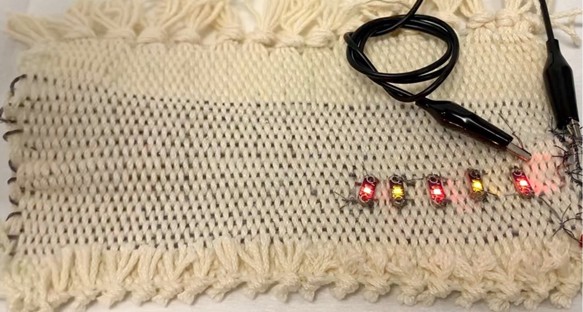
Fiber batteries are an emerging technology which could one day be used to create smart clothing with a wide array of functions, from charging electronic devices to acting as wearable controllers. However, a new study finds scientists have two major obstacles to overcome before the technology is ready for practical use.
First and foremost is encapsulation, which refers to the materials in which the battery components are housed. Oxygen and moisture exposure accelerate lithium-ion batteries’ degradation and lower their effectiveness, so the outer casings of the batteries must be able to keep those elements out. With fiber lithium-ion batteries specifically, the materials must also be flexible enough to act like yarns that can be woven into clothing.
To assess the viability of different encapsulation methods, researchers measured four characteristics:
- Water vapor transmission rate (WVTR), which measures the amount of water vapor that can permeate a surface,
- Cyclic capacity retention, which refers to a battery’s ability to continue storing energy over the course of multiple charge and discharge cycles,
- Internal resistance, and
- Calendar life.
Researchers evaluated five strategies, ranging from early methods, like sheathing batteries in polymeric tubes, to promising new technology like liquid metal encapsulation. Each method showed strengths, but also lacked in one or more critical areas. Even the liquid metal, which was both highly water resistant and flexible, was found to be so complicated and costly that it is still not yet a viable option.
Mengli Wei, graduate student in the Wilson College of Textiles at North Carolina State University (NCSU) and lead author of the study, said that solving this problem was the most pressing issue facing fiber battery researchers. She said that doing so might be done with experts from another field—the packaging industry.
“This is a large industry just focused on packaging, and they have unique techniques to block both oxygen and water,” Wei said. “If we can tap into their expertise, it could help us make significant progress on this technology.”
The second problem researchers looked at was mathematical modeling, which scientists use to predict the output of yarn batteries based on an array of different parameters. Specifically, models could help researchers better predict the relationship between battery chemistry and the maximum effective length of yarn batteries.
Previous studies have found that as yarn length increases, so does the output of the battery, but those gains in efficiency and output eventually fall off. Wei Gao, an associate professor in the Wilson College of Textiles and corresponding author of the study, said that existing models struggle to accurately predict these outcomes even when the underlying mechanics of the batteries are understood.
“The length effect is determined by the inherent physics of the fiber battery configuration, which we learned from experimental data,” Gao said. “The problem is that the models are not accurate enough to predict the effects of different device variables. If the model is accurate, we can plug in different device parameters, and it can predict the optimal battery length. That way we would be able to provide better guidance when making fiber batteries for practical applications, such as their incorporation in textile fabrics and garments.”
Assistance from electrochemical experts could be valuable in refining these models, Gao said.
The paper, “Toward Real-Life Applications of Fiber Lithium-Ion Batteries,” is published in Small. Co-authors include Nanfei He, Seongjin Kim and Andrea Lee of NC State University.
This research is based upon work supported in part by the Office of the Director of National Intelligence (ODNI), Intelligence Advanced Research Projects Activity (IARPA), and in part by the US Army STTR project contract W5170126CA006.