 TEXTILES.ORG




Summer is a time for rest and renewal, much needed to bring fresh energy and perspective to challenges facing the textile industry. The work of The Finnish architect and designer Alvar Aalto (1898-1976) is particularly inspirational at this time in considering how some persistent user issues around e-textiles and wearables might be addressed. Aalto is one of the pioneers of humane modernism that prioritized comfort, context, tactility and warm, natural materials as a counterpoint to harder metals and glass.
A visit to the exhibition, “Aalto Design: Shapes of Wellbeing,” at the Architecture and Design Museum in Helsinki, the Aalto Studio, Finlandia Hall, and finally the Paimio Sanatorium, for which Aalto was the architect, offered me an opportunity to reflect on his influence evidenced in the exhibition, and sanatorium in particular, as they are so directly connected to design considerations for health and wellness.
Emerging textile market segments, such as e-textiles and other smart fabrics used as “wearables,” have unique challenges simply because they must accommodate the many variations of the human body and still be prepared to market a product that will gain sufficient commercial acceptance. This challenge is augmented when it applies to health, wellness and medical wearables.
So, it can be useful to look to design theories outside of the textile industry and applied in a larger context to what humans need to live and the choices we make. Non-textile-specific applications may present a solution to a problem that has lingered with smart fabric technology wearable applications: that is, acceptance by both the wearers and, in some cases, caregivers, as well.
The global wearable technology market is expected to grow from $104.95 billion in 2026 to $238.71 billion by 2032, at a CAGR of 14.7 percent, according to a report from Markets and Markets. Long-term monitoring is embedded in many of the key growing market areas, such as elderly care, remote patient monitoring and sleep analysis. A key issue facing wearables is user-engagement over extended periods of time where products perform technically but often fail to engage the user or care giver sufficiently. This is where design can make a difference.
Managing long-term health issues
Alvar Aalto’s Paimio Sanatorium was conceived as an instrument for healing adults with Tuberculosis (TB) built in 1929-33, before the advent of antibiotics in the mid-1940s. Located among the pine trees of Paimio near the southwest boarder with Sweden, the design was initially influenced by international functionalism but the finished design moved towards humane modernism with a stronger emphasis on human psychology and the sensory experience.
Details include washbasins that dampen the sound of running water and wards with windows placed low designed from the perspective of patients standing up as well as lying down to allow them to see outside. With patients spending between eight and eighteen months at the facility all aspects of the building and interior design were directed at long-term stays.
In wearables design there is an important focus on purpose, function and reliability, as well as wearability, size and fit. Long-term use is largely considered in these terms, but at the same time it is widely acknowledged that user-engagement over extended lengths of time remains a challenge that goes beyond the functional.
Taking inspiration from Aalto’s humane modernism approach, purpose and functionality need to be seen as a starting point. There is also a need to expand user-centered design beyond wearability, size and fit and to ask, “What are the human psychology and the sensory experiences that wearables and e-textiles design should consider?”
The challenge is determining what these might be, gathering insights from wearers as well as care givers and other stakeholders, then balancing these against function, manufacturing, laundry, cost and other factors. In the case of vulnerable groups engaging with associations (such as those concerned with Alzheimer’s, dementia and autism) can perform a crucial role in this.
Color and light
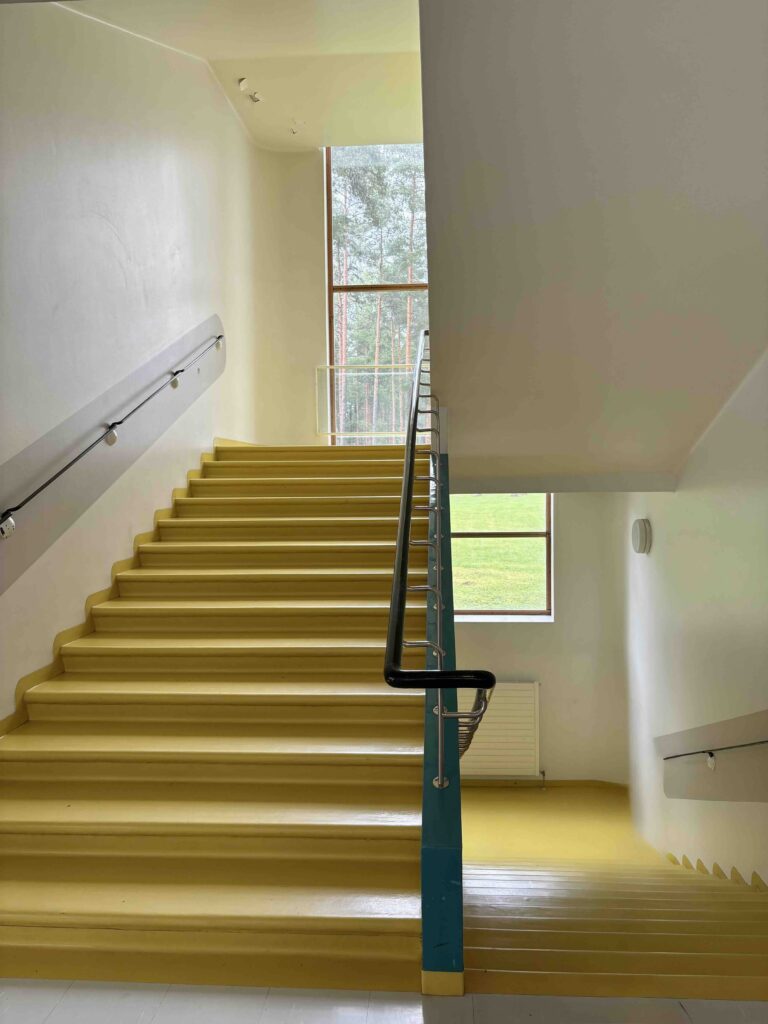
Smart textile applications can learn from a high level of attention to color and light in this iconic healthcare setting. The sanatorium stands out from the green pine trees that surround it as its curved white walls are punctuated by lines of bright colour offered by the retractable awnings along the windows on each floor offering contrast against the vertical lines of the pine trees from every viewpoint.
Inside, the bright yellow reception desk and linoleum floors of the building main staircases were designed by Aalto and decorative artist Eino Kauria. The specially commissioned color for the building was designed to uplift the mood and bring sunshine. Light was carefully controlled in the light vs. shade design and indirect placement, with color playing a role with light-coloured walls and a darker ceiling painted in muted green to reduce glare and contribute to a calming ambience.
In wearables, color and light are both used as a visual shorthand to help reveal what are often very complex psychophysiological and physiological data signals. These can help in digital phenotyping showing patterns of stress or sleep, and mental and psychological health.
The second use is in chromotherapy with LEDs integrated into or onto the textile for applications such as skin health to promote collagen production or reduce inflammation, for stress and pain reduction and to support sleep regulation. The textile fibers and fabrics are largely treated as the substrate and afforded a passive rather than an active role.
As we move towards greater integration of electronics, including miniaturized LEDs, into the fiber, now is a time to focus on what the textile aspect can bring using structure, surface and color to amplify and not just to support.
Wellness for every day
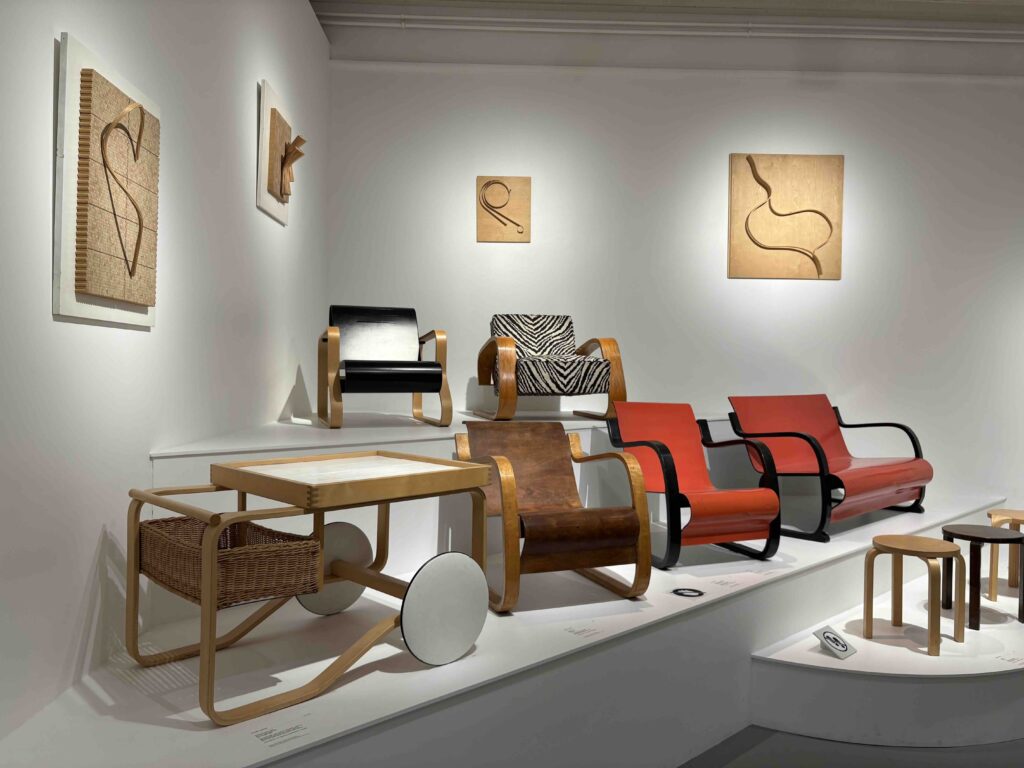
Alvar Aalto’s humane modernism philosophy of design moved fluidly between architecture, product and furniture design. Purpose and function are a starting point, with the architect and designer embedding the user and community’s comfort, aesthetic and emotional experience central tenets.
His use of organic form in the reception kiosk at the entrance lobby of the Paimio Sanatorium (1929-33), offer a welcome in both form and its bright yellow color. (The curved form is also used in his design for the glass Savoy vase (1936), more commonly referred to as the ‘Aalto’ vase, as the architect and designer sought to soften what he saw as a harshness of modern environments by introducing natures rhythm and sensory pleasure to objects to be used in everyday life.)
Aalto also collaborated with the cabinet maker Otto Korhonen to develop a method for bending timber and plywood that would offer furniture forms that contoured to the shape of the human body. They developed an innovative technique using glue and hot steam, which has been used in furniture, including the iconic Paimio chair (1932), since then.
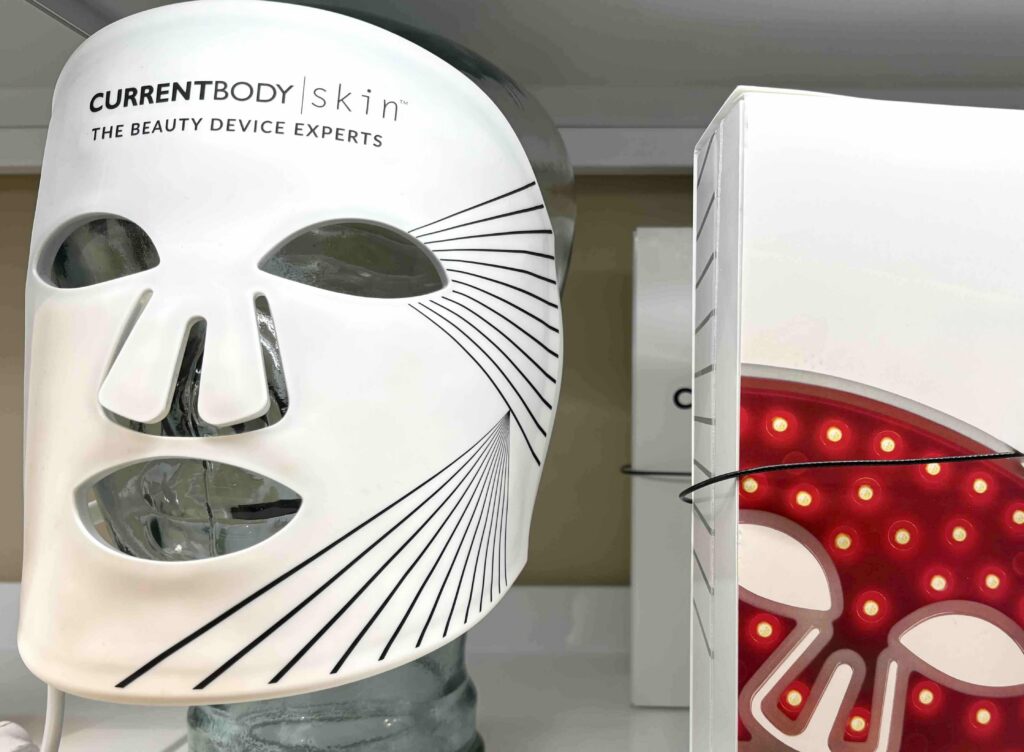
Wearables for health and wellbeing can often reach the consumer product sector first; fitness monitoring is an example. These can then be further developed for the medical sector where they undergo more lengthy, costly and rigorous approval processes. A successful consumer wearable that transitions to a medical product offers other advantages, such as refining the manufacturing process and financing.
The alternative approach is curb cut where an innovation moves in the other direction from a successful device for medical or disabled applications is adapted for use in an everyday consumer product. As with Aalto’s design or in wellness, wearables’ purpose and function are expected, so that it is comfort, aesthetics and the emotional experience that become critical for the user to adopt it — and to remain engaged.
Dr. Marie O’Mahony is associate professor at the University of Southampton, an industry consultant, the author of books on advanced and smart textiles, and a frequent contributor to Textile Technology Source.