 TEXTILES.ORG




The Global Electronics Association through its IPC standardization efforts has been a driving force in global electronics standardization for nearly 70 years. The last time we checked in with Advanced Textiles readers, you may have known us as IPC. In summer 2026, our organization went through a rebranding effort—an evolution in our organization that reflects the increasingly diverse ecosystem we serve, including the fast-growing world of e-textiles.
The association is built on a vision of better electronics for a better world, supported by a vision to promote industry growth and strengthen supply chain resilience. With more than 3,200 member companies in 90 countries, the association brings together international groups of technology innovators, engineers, manufacturers, OEMs and product brands, and academia to support a growing library of more than 300 standards for the electronics industry. This library is based on the work of thousands of standards contributors who participate in open, consensus-driven processes to help technologies move from concept to design to reliable, market-ready products.
E-textiles are at exactly that inflection point. From biometric monitoring garments and smart medical wearables, to wearables for the soldier of the future, connected worker systems, adaptive automotive interiors and responsive consumer products, the potential for integrating electronics directly into textile systems is enormous. Even still, translating that potential into scalable, reliable and commercially viable products has remained a challenge. This is not because the technology isn’t ready, but because the frameworks, terminologies, reliability assurances and shared reference points—which are needed to support incredibly cross-disciplinary development teams—have been lacking or missing entirely.
Reliability is at the heart of that challenge. Unlike traditional electronics, e-textiles must maintain functionality while enduring repeated flexing, stretching, abrasion, moisture exposure, temperature variation, and washing cycles—all while preserving comfort, wearability and manufacturability.
The association, through its IPC standardization efforts supported by a global network of e-textiles specialists from more than 20 countries, is addressing these issues head on. Over the past several years, these working groups have dedicated time and resources to a growing library of standards, test methods and guidance serving as the comprehensive global framework for the e-textiles industry, spanning yarn characterization, reliable integration of electronics into textiles, design, qualification and performance testing and even system-level reliability. The following highlights the standards, test methods and guidance now shaping the global e-textiles framework.
Testing for the real world
IPC-8981, Quality and Reliability of E-Textiles Wearables, released in April 2025, establishes the first comprehensive global testing and reliability framework for e-textile wearable products. It defines standardized durability and exposure tests that mirror real-world conditions across the full product lifecycle, including:
- Abrasion
- Stretching
- Flexing
- Tensile behavior
- Torsion
- Bending
- Temperature and moisture
- Acid
- Alkalis
- Water and saltwater
- Perspiration
- UV exposure
- Washing and drying
Products can be tested against each of these characteristics using 14 new IPC Test Methods developed specifically for e-textiles testing. To measure performance the product is also tested for electrical and sheet resistance before and after being subjected to each of these methods to measure the change in electrical resistance as a result of the exposure.
The standard aligns exposure expectations to the IPC Product Classification System, scaling from Class 1 (commercial) through Class 3 (mission-critical) and allows for provisions for short-term and single-use applications such as disposable health-monitoring patches (e.g., disposable EKG would be tested to Class 3, single/short-term use limits). This ensures a product is tested in accordance with the real-world exposures it will face.
IPC-8981 also defines the identification of functional and critical areas of a product for testing. This is a practical approach to testing according to industry standards, reducing product waste and enabling manufacturers and their customers to ensure testing focuses on the product areas that matter most.
Let’s put this standard into action. Consider a single-use neonatal monitoring wrap used in a hospital setting to track vital signs during transport between units. Because performance-on-demand is critical and failure could affect clinical decision-making, the product may be specified by the customer as Class 3. However, because it is intended for short-duration use and disposal after use on the patient, the customer and supplier can agree to identify it as a Class 3 single-use/short-term use product.
In this case, rather than the product being tested as if it must survive months or years of repeated laundering and wear, testing can focus on standard-identified limits for single use and short-term duration of performance. Testing for conditions irrelevant to the intended use (in this case, laundering) can then be avoided.
Qualification testing can further define only the essential items of the product by focusing qualification on the areas of the product that matter most. Functional areas could include the conductive pathways, sensor zones, connector attachment points and any textile-integrated circuits. Critical areas would then be a subset of those functional areas where failure would most directly affect product performance or patient safety, such as the sensor interface, interconnect locations between the textile circuit and electronics module, or conductive traces that will experience bending during placement or removal.
The result is a more meaningful qualification plan that focuses on rigor specifically where reliability matters and is not burdened by testing for exposures the product will never experience.
Reliability from the conductive yarn up
Product reliability starts at the most fundamental level of the supply chain. It was for this reason that we developed IPC-8911, Requirements for Conductive Yarns for E-Textiles Applications. Released in May 2025, it represents the first global standard dedicated to characterizing and testing conductive yarns. IPC-8911 provides many essential benefits to the supply chain. It introduces a clear designation system which streamlines communication between yarn suppliers and product developers, simplifying procurement decisions and reducing development risk.
To put this into a real-world example, a conductive yarn used in biometric monitoring garments, smart PPE or ECG straps is a silver-plated polyamide (nylon) multifilament yarn. Its IPC-8911 designation would be specified on the product order as: IPC-8911/Y2-F2-M1/NC(PA) where:
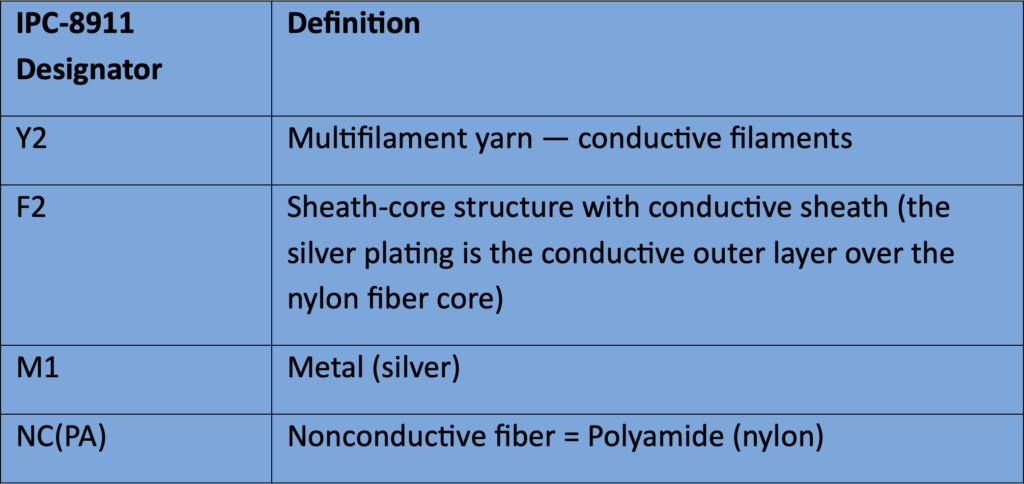
This designation system gives a yarn supplier an unambiguous, standardized description of exactly what material is required, removing the need for back-and-forth clarification on construction type, fiber structure and base material, which is the supply chain communication problem IPC standards are designed to solve.
From a characterization perspective, the standard calls out eight new IPC Test Methods developed specifically for conductive yarns. This provides buyers of conductive yarns an “apples-to-apples” means to compare and assess similar conductive yarns from the same or multiple suppliers through industry-defined test methods to show product performance against real-world mechanical, electrical and environmental demands.
Building on that materials foundation, IPC-8921, Requirements for Woven and Knitted Electronic E-Textilesestablishes the classification and qualification requirements for woven and knitted e-textiles. Its upcoming Revision A will align the standard with the IPC-8911 yarn designation system and expand the scope of the standard to include braided products. Additionally, the standard will bring qualification testing for these products into the IPC Classification testing categories used in IPC-8981, incorporating the same new IPC Test Methods developed for IPC-8981.
This provides a consistent approach in qualification testing from manufacturing of the e-textile to the end-product wearable covered in IPC-8981. The end result is a unified performance framework that applies consistently across three e-textile types, based on separate manufacturing processes, but which are all expected to apply to similar performance metrics. The working group responsible for IPC-8921A plans to release this standard by the end of the calendar year.
A parallel path: printed electronics
Conductive yarn-based e-textiles are one major pathway for integrating electronic functionality into soft systems, but they are not the only one. Printed electronics technologies have seen a lot of use in textile-based applications. There are three specific standards that address these e-textiles systems.
1. IPC-8952, Design Standard for Printed Electronics on Coated or Treated Textiles and E-Textiles, released in 2022, was the first design standard for this space, adapting printed electronics on flexible substrates design practices to textile substrates. It defines documentation, materials selection, trace layout, dielectric structure and component-interface requirements to ensure electrical stability and product durability.
The standard also utilizes the Standard Printed Electronics Design (SPED) structured system for identifying process steps for developing a product. Each SPED (SPED 1 through SPED 3) maps printed processing steps for clear communication between designer and production teams to reduce or eliminate ambiguity and improve yields.
2. IPC-8971, Requirements for Electrical Testing of Printed Electronics on E-Textiles, complements IPC-8952 by defining how printed electronic features on textile substrates should be electrically evaluated. It focuses on confirming that printed conductors and conductive patterns meet their intended electrical requirements (continuity, isolation, and resistance) so product can be consistently validated.
The standard is also supported by IPC Test Method Conductor Temperature Rise Due to Current Changes in Conductors for Printed Conductor Materials on Textiles, which provides a practical way to evaluate how printed conductors behave under electrical load. The method measures conductor temperature rise caused by resistive heating as current changes, helping designers understand how conductor material, geometry, deposition process and textile substrate influence electrical and thermal performance in printed e-textile designs.
3. The newest addition to this printed electronics ecosystem and our e-textiles standards, coming soon to our library, is IPC-8922, Qualification and Performance Specification for Printed Electronics on Coated or Treated Textiles and E-Textiles. IPC-8922 builds on IPC-8952 by establishing qualification, performance and acceptance requirements for printed electronic e-textiles.
The standard also brings printed electronic e-textiles qualification testing into the IPC Classification testing categories used in IPC-8981 and IPC-8921A. Again, this provides a consistent approach in qualification testing from manufacturing of the printed electronic e-textile to the end-product wearable covered in IPC-8981.
Together, IPC-8952, IPC-8971 and IPC-8922 provide a comprehensive path from printed e-textile design to electrical test, qualification and production acceptance.
Connecting the product development dots
All of the standards discussed here define requirements and the specific test methodologies used to assess characteristics against those requirements. By their nature, standards are direct, precise and written to minimize ambiguity. That precision is essential, but moving from prototype to product also requires something broader: a shared understanding of how disciplines, materials, integration methods and failure modes connect at the system level.
Developing successful e-textiles requires expertise from industries that have historically worked in very different ways.
Textile engineering, electronics manufacturing, materials science, garment design, software, sustainability, cybersecurity, human factors and end-user behavior can all intersect within a single product. Decisions made in one area often affect performance in another. A textile structure can influence electrical routing, stretch behavior, laundering durability, interconnection reliability and user comfort. A conductive pathway that performs well on the bench may behave differently once it is stretched, washed, abraded or worn close to the body.
To help address this system-level challenge, the Global Electronics Association released Fundamentals and Best Practices for E-Textile System Development, the first publication in the association’s Technology Solutions Next-Generation Guidelines. Developed by an international working group of industry and academic experts, the guideline covers reliability characteristics, materials and components, integration methods such as weaving, knitting, braiding, lamination, embroidery and conformal coating, interconnection approaches, product examples, sustainability, cybersecurity and end-user guidance.
The guideline complements the standards by helping teams consider the broader development context before materials, test plans and manufacturing routes are locked in. Additional information about this new guideline is available at: https://www.electronics.org/next-generation-guideline-fundamentals-and-best-practices-e-textile-system-development
A framework built to evolve
The IPC standards and new guideline covered here together form a comprehensive, interconnected framework for the e-textiles industry. None of these documents are static. They are built and maintained through the collective expertise of a global supply chain and will continue to evolve as e-textiles move from promising innovation toward commercially mature technology. As new materials, integration methods, product categories and reliability challenges emerge, the Global Electronics Association will continue working with industry to revise existing standards and develop new resources where gaps remain.
As a first step, we invite readers to add these standards, test methods and the guideline to their technical library. The standards and guideline are available through the Association’s bookstore, and IPC Test Methods are available for free download at https://www.electronics.org/test-methods. Used individually or together, these resources can help teams align on expectations earlier, reduce redundant testing, compare materials and products using common methods and improve communication between customer and supplier.
Equally as important, these documents will continue to evolve. Future revisions will depend on continued and expanded contributions from industry. Whether you want to lead new standards work or contribute to next versions, there is a place for your perspectives.
Chris Jorgensen is senior director, Next-Generation Standards, the Global Electronics Association. To learn more about these projects as well as others that are in early stages of development, contact ChrisJorgensen@electronics.org or the association’s e-textiles staff liaison Francisco Fourcade at FranciscoFourcade@electronics.org.