 TEXTILES.ORG




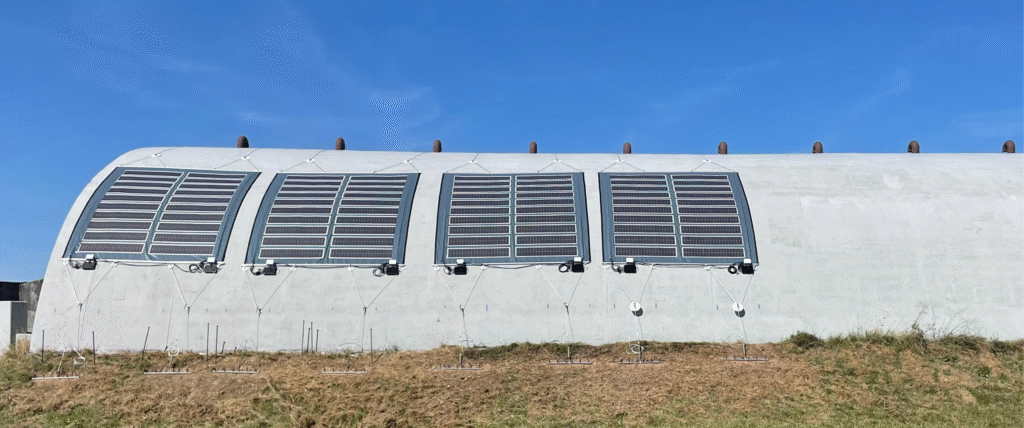
Military, commercial and industrial customers choose solar for varied applications.
Editor’s note: The word “uncertainty” has been used more often in the last year than I can ever remember. There’s uncertainty regarding international trade, funding for new research, the current administration’s support—or lack thereof—for alternative energy, and many other areas that impact business decisions. This includes solar fabrics—or photovoltaic fabrics—as used in architectural applications.
There are a number of market reports available on photovoltaic fabric products, but they focus on smart fabrics in wearables, not structures, such as deployable tents or hybrid structures that incorporate solar capability to generate power for the entire space. There are also market reports on various types of solar generating systems, and some may be functional in larger, architectural applications. But, in truth, the solar fabric market beyond wearables and smaller, personal products, such as backpacks or purses, is limited to the brave few.
One of those is Colin Touhey, CEO of Pvilion, a company headquartered in Brooklyn, N.Y., that specializes in solar-powered textile tents, canopies, sails and other structures. It’s a niche in the sustainable energy industry, to be sure, but it has proven to have staying power and potential for growth, garnering customers in markets as varied as the military, emergency response and agriculture.
We asked Touhey to provide some insights about the industry for photovoltaic fabric products beyond wearables markets. – Janet Preus, senior editor, Textile Technology Source.
Q: How is your niche in the larger solar market faring right now?
A: There is thankfully still a pretty high demand for turnkey products like ours. In particular we have seen a major growth in the need for temporary power and shelter solutions. There are countless organizations that need temporary/mobile shelter and instant power. This includes companies in the disaster relief, event, defense, agriculture, industrial and construction industries.
Q: Have you noticed the current administration’s impact on the solar energy industry?
A: Absolutely; there have been way too many policy shifts to not notice the impact that the current administration has had. It’s disappointing to see tax credits, research programs, and incentives have been defunded or removed all together. We’ve seen a lot of solar, battery and other clean energy companies have to downsize or shut down, and we have certainly felt the effects, too. Thankfully, since our focus is a little more specialized, we have still seen the demand for our products.
But we have definitely had to think about how we want to communicate our products’ message with the narrative around “climate tech” being so uncertain right now. I would say that all contributors to these climate tech marketplaces will feel the effects.
It’s not just the manufacturer of clean tech products; it also trickles down to all the vendors that make up the climate tech supply chain. Any textile company that provides materials to clean tech companies will be impacted by recent policy changes, even if their product isn’t specifically clean tech. However, a lot of these changes may be a branding change more than anything.
For instance, there was a trend towards brands using “green,” “sustainable,” and “clean,” in their marketing, product names, and advertising. The rebranding away from that will not make these products less green, sustainable, or clean; they simply won’t be communicated that way to the public.
Q: What markets are you seeing the most interest from right now? For what?
A: Currently, we see the most interest from the U.S. government, specifically the Air Force, and emergency response organizations, for a product line that’s a mobile turnkey solution, which can provide rapidly deployable fabric shelter, solar, power supply, and any other necessary equipment, in a user-tailored kit that’s packed for relocation ease.
Q: What alternatives are out there to meet this type of need? How does the situation impact both solar textiles markets, but also other advanced textiles market niches with whom you (and others) may do business?
A: Usually, the need for power and shelter are addressed separately with temporary shelter systems and traditional generators from different providers. It is more costly to purchase fuel 24/7 over the course of a year than purchase our products, so at the end of the day it isn’t just about sustainability; it’s about bottom line. We can’t speak to how this is specifically impacting other textile shelter system manufactures, but we have still seen demand. However, there are not really any other companies providing the same turnkey solar textile and power systems as us in these markets that we have seen at this time.
Q: What about the commercial market, is there demand there?
A: Yes. We are based out of New York where there is still a desire to strategically advance clean tech. We are working with several local organizations on commercial solar fabric products and have been involved in some great clean tech industry events.
One commercial project that we are currently installing is our Quad Pole Solar Canopy for We Stay Nos Quedamos in the Bronx. Our canopies will be used in the organization’s community gardens throughout the Bronx as a part of their Resiliency Hub program. The canopies provide emergency power and a rainwater collection system, and, in an emergency, it will act as a hub for the distribution of mutual aid.
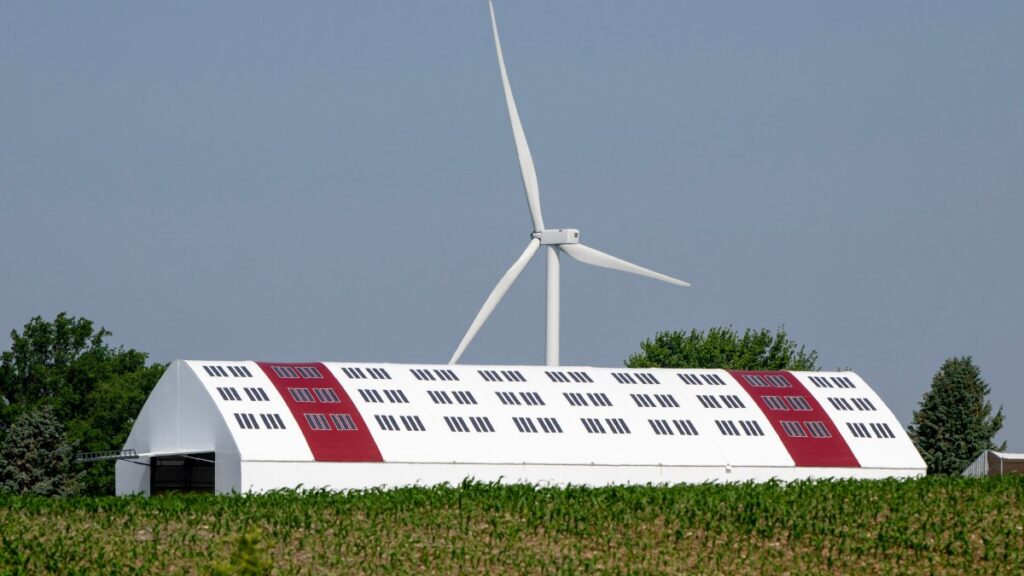
One industry that we’ve seen significant interest from recently is the industrial agricultural space. For example, we partnered with Iowa-based Accu-Steel to provide our Industrial Solar Structure, engineered to integrate advanced solar technology with a high-capacity battery system that can replace traditional 25–50kW generators to power heavy duty farming equipment.
Q: “Big ag” may be particularly in a position to open up a larger market. But smaller operators, too, may have reached the point where they can make a solar textile product viable. I also wonder about availability for places like less populated areas in the agricultural Midwest.
A. What’s great about this tech is that it is modular and can be scaled up or down. We’ve seen the most interest recently from large farms in the Midwest because the amount of solar generated by the large fabric buildings they operate under generates enough power to replace traditional, polluting generators. With that said, it’s still a solution available to smaller operations, as well.
Q: It seems that there aren’t a lot of solar energy companies that incorporate textile products or make/sell solar textile installations.
As mentioned, there aren’t many other companies that are integrating photovoltaic textile shelter systems with battery systems in the same way. [But] there is always a lot of exciting emerging technology.
Q: You recently announced plans to expand.
A: We began the process at the end of 2025 and made the announcement earlier this year. There has been a surprising amount of international interest, which has led to some interesting discussions about global expansion to help meet international climate initiatives.
Q: What do you hope to see for the solar energy industry in 2026?
A: There is still a real need for power, especially in remote and industrial applications. Solar has significant benefits to offer, regardless of the current political “hot topics.” It’s unfortunate that it’s become somewhat controversial during the current political climate, but we remain optimistic that the advantages will remain worthwhile, despite the policy changes taking place under the current administration.
As the technology continues to advance, we believe solar and storage will continue to be a clear competitor to traditional temporary power systems. We are always excited to see new emerging solar technology and support the development of new sustainable solutions.