 TEXTILES.ORG




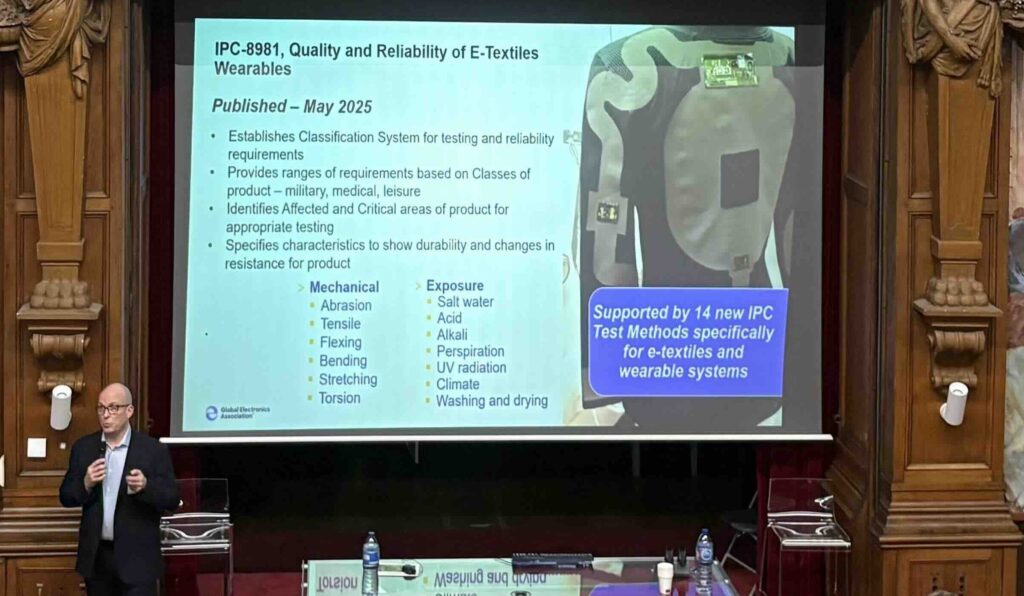
Protective clothing is becoming smarter, with e-textiles bringing new capability in health and environmental monitoring that’s paired with location tracking to offer protection for workers in hazardous locations. At E-Textiles 2025 in Lille, France, a number of European advances were presented around smart protective clothing with new developments including uniforms, footwear and protective gloves for military and firefighter uniforms.
Fighting chemical hazards
The FireSafeProtect is a European project to design interventions for the protection of the health of firefighters in hazardous conditions. The project is centered around material research and runs from 2025 until 2028, with research lead by the Research and Innovation Center for Electrical Engineering (RICE), attached to the Faculty of Electrical Engineering of the University of West Bohemia in Germany. It addresses the issue of exposure to carcinogenic polycyclic aromatic hydrocarbons (PAH’s), the harmful chemicals that can come from burning matter, which can cause DNA damage and increase cancer risks for the skin and lungs.

These chemicals can penetrate the skin when the firefighter is wearing contaminated or insufficiently decontaminated suits. In the FireSafeProtect development, sensors are being incorporated into the clothing, using optical methods and nano structures that have the ability to detect contamination. There is an additional clothing maintenance system that is also being included.
Also in Europe, ProeTEX (Protection e-Textiles: MicroNanoStructured fiber systems for Emergency-Disaster Wear) falls within the 6th Framework Information Society Technologies (IST) Integrated Project. It involves more than 20 consortium partners from academia and industry, including apparel manufacturer Smartex, the University of Ghent, Dublin City University and Philips Research. The development incorporates a technology from product development firm and medtech manufacturer Biotex—part of the same European research. This technology has led to the development of a range of sensors that are capable of measuring sodium, potassium and chloride in sweat samples, as well as an immune sensor that can detect the presence of specific proteins in fluid samples.
An additional development is a process to channel minuscule droplets of liquid from the skin, to the textile, to the sensory unit. In ProeTEX the technology is integrated with other micro and nano systems with photovoltaic and thermoelectric energy storage. The project has been directed to the development of smart wearables for emergency disaster intervention personnel.
The goal is to improve safety for personnel and injured civilians to optimize survival management by detecting a range of health parameters. These include heart rate, breathing and body temperature, as well as environmental variables, such as external temperature, the presence of toxic gases, and heat flux passing through the garments. Ultimately, the technologies are seen as being of use in other applications for sports, healthcare, transportation, maintenance, construction and other workers.
User-centered smart gloves
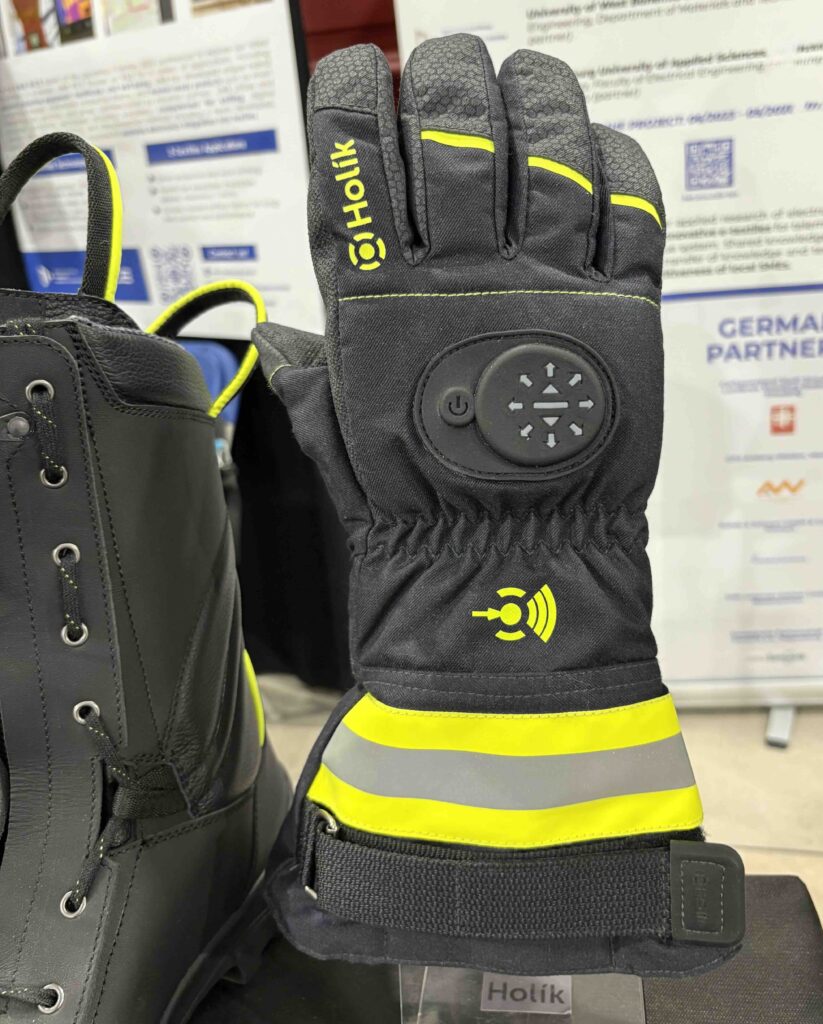
Holík International is a Czech family-owned company specializing in the development and manufacture of premium gloves, footwear and firefighting suits. Integrated into protective footwear and gloves, its ILOC localization and navigation system is designed for rescue operations in hazardous and challenging environments where more traditional navigation systems, such as satellite or ground-based radio systems, are unreliable or unavailable.
The design is user centered, with full integration of the navigation and localization systems so that the wearer could go about their duties unimpeded. For distance communication, remote wireless data transmission is used between the main control unit (MCU) and cloud system using a 4G or 5G network. An LED compass is used for navigation purposes and is integrated into the work gloves, giving the user access to an intuitive visual navigation without the need for an additional device, or additional manipulation of it.
Using integrated electronics, the work gloves can provide details of current position, status indicating features, a multifunctional button, with an independent power source and wireless data transmission using radio frequencies. There is low demand on the wireless communication infrastructure due to the small amount of transmitted data between each of the system’s devices (glove, boot, MCU).
Performance and comfort
ARMETISS is a European Union and European Defense Agency Commission co-funded project directed at bringing together cutting-edge textile technologies to meet the protective challenges faced by future defense personnel. There are 18 partners in the project that is led by the NFM Group. Drawing together leading soldier equipment, manufacturers, research, knowledge and technology providers, along with system integrators that come from both the military and civilian sectors, the collaboration is focused on building next-generation personal protection equipment.
The technology centers around the integration of sensing, actuation and digital intelligence directly into the textile structure. The approach treats the body as a dynamic interface, with the clothing in constant contact with the skin, taking account of movement, heat and moisture. Washability, mechanical strain and long-term wear are important considerations in the design and development process.
The link between user comfort and performance is now well acknowledged, and the development addresses comfort through strategies such as thermoregulation and physiological monitoring that implement health metrics tracking for soldier well-being and better medical support. The overall design incorporates Geo-positioning technology to boost navigation, particularly in global navigation satellite system (GNSS) environments.
Overall, safety is improved alongside protective equipment durability with real-time armor fracture detection in place of x-rays. Ergonomics are also addressed providing intuitive controls for the human machine interfaces (HMI), as well as streamlining power and data distribution to reduce weight and wiring for soldiers’ comfort and safety.
Dr. Marie O’Mahony is an academic, industry consultant and the author of several books on advanced and smart textiles published by Thames and Hudson. She is based in London.