 TEXTILES.ORG




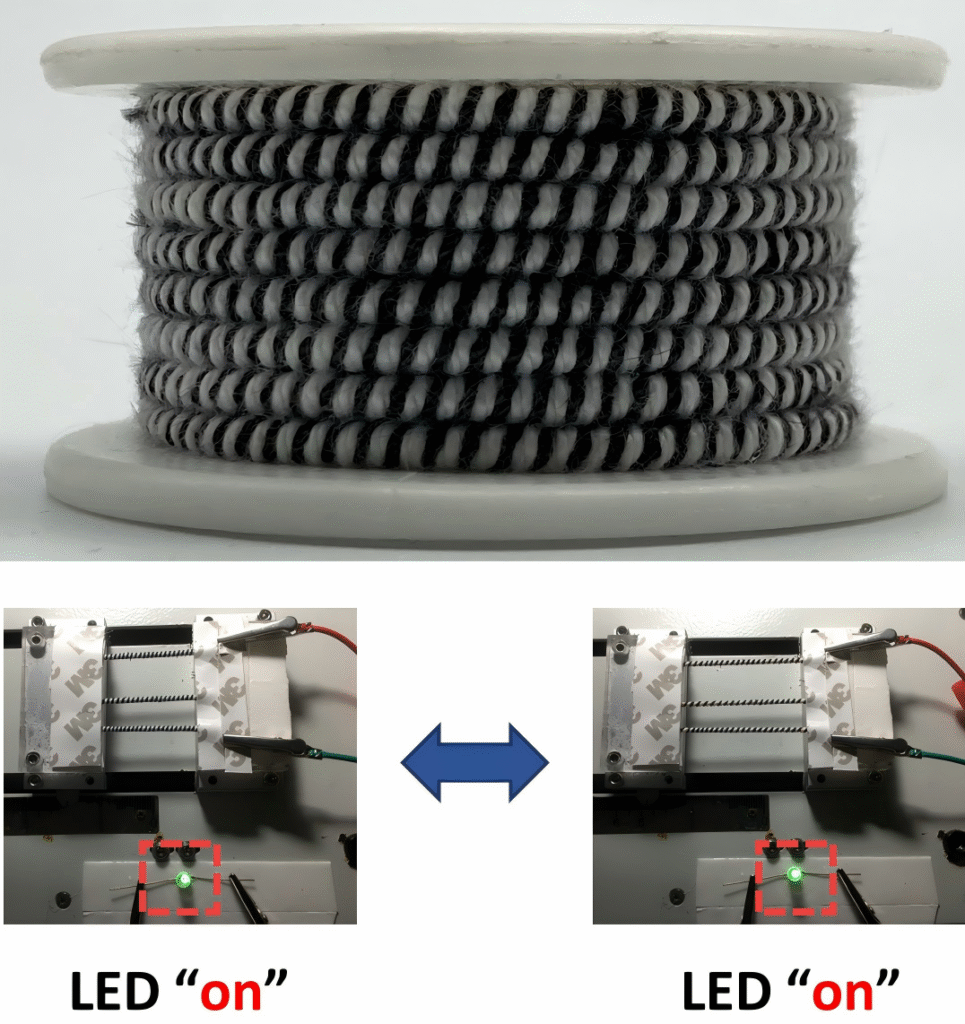
Incorporating sweat-activated batteries into smart fabrics for athletic use may have jumped another hurdle. Researchers at the School of Materials & Energy, Southwest University in China developed a fiber wrapping technique to create these types of batteries in yarns, enabling them to be stretchy. This is key to incorporate them into wearable textile electronics.
“While SAYBs [sweat-activated yarn batteries] have demonstrated remarkable tolerance to thousands of repeated bending and twisting cycles, their lack of stretchability, particularly the absence of strain-insensitive output characteristics, significantly impacts wearer comfort and limits their practical application in wearable electronics,” the study says.
The solution was a combination of zinc wire wrapped in cotton for the core, with the core and carbon yarns then wrapped in parallel onto a polyester-layered elastic substrate. Electrolytes from sweat are absorbed into the cotton and polyester and power the battery.
The team designed a machine to produce them and they could be scaled to meter-long strands.
“The S-SAYBs [stretchy sweat-activated yarn batteries] can be … seamlessly integrated into electronic textiles through traditional techniques, such as weaving, knitting, sewing, and stitching,” says Zhisong Lu, professor and senior author of the study.
The yarn batteries were incorporated into a headband and T-shirt. Volunteers using the headband had different head circumferences and wore the device while exercising on a spinning bike; the batteries lit up LEDs. The yarn batteries in the T-shirt powered a pedometer for a volunteer on a treadmill.
Researchers also subjected the yarn batteries to 20 washing cycles and saw a slight decrease in open-circuit voltage after the first five cycles but then the change remained stable. Future work may look at device integration, different compositions of sweat and “promoting the upgrade of wearable devices from single function to intelligent systems,” the release says.
The work was published in Wearable Electronics in December 2025.
See Specialty Fabrics Review‘s Swatches section every month for short stories covering news, ingenious projects and research.