 TEXTILES.ORG




There are a number of reasons why the success of biomedical textiles in recent years is worth noting. First, it’s a demanding market niche fraught with standards and regulations that take time—and time is money. The investment needed to even start in this market is considerable. It’s also highly specialized, which means that the cushion that diversification in a product portfolio might provide may not be a viable option.
Nevertheless, the market has grown and is predicted to remain healthy. Research firm Mordor Intelligence valued the biomedical textile market in 2025 at $16.78 billion, and it estimates the market will be $17.75 billion in 2026 and reach $23.51 billion by 2031, at a CAGR of 5.78 percent in the forecast period.
Modor Intelligence’s report suggests that growth rests first on the expanding surgical workload created by older populations. It also reflects the commercialization of minimally invasive implantable fabrics, and steady public-sector funding that has picked up on defense textile research to repurpose these materials in civilian care markets.
Interestingly, non-biodegradable fibers had more than half of the market share in 2025, but biodegradable fibers are projected to show growth through 2031. It’s no surprise that nonwovens hold more than 60 percent of the market and will show 8.14 percent growth annually to 2031.
Intended use
At the Advanced Textiles Expo in November 2025, Alexander Laubach, a chemist with the Hohenstein Institute, shared information on how to understand the difference between a medical product and a medical device. More to the point, he explained why anyone moving into this market space needs to be clear on how relevant this is.
The short answer is that identifying a medical device is “all about the intended use,” he said. “Things you can materially touch … you should consider that you could have a medical device,” which has more stringent regulations than a medical product. That said, the regulations (U.S., EU and Canada) are not very clear, but there is a process that can be reliably followed. Safety, of course, is paramount, and it requires a serious testing regimen.
Nevertheless, amazing accomplishments in biomedical research have yielded successfully commercialized devices that are commonly used in hospitals and clinics worldwide. There are also promising new products on the horizon.
Breakthrough research
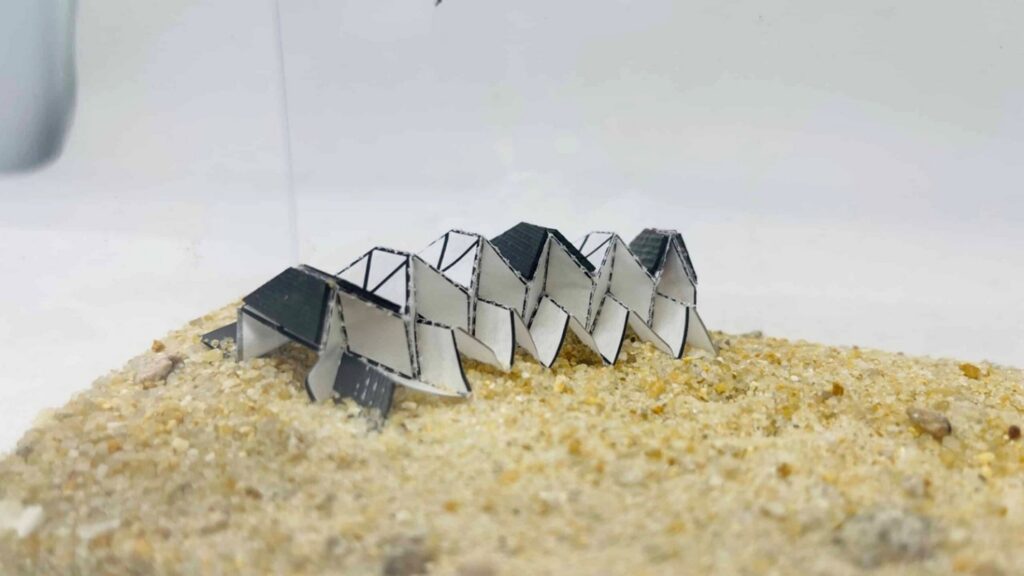
Just last fall, researchers at North Carolina State University (NCSU) announced “how origami robots with magnetic muscles could make medicine delivery less invasive and more effective.”
NCSU News Services shared, “By infusing rubber-like elastomers with materials called ferromagnetic particles, the researchers 3D printed a thin magnetic film which can be applied to origami structures. When exposed to magnetism, the films acted as actuators which caused the system to move, without interfering with the origami structure’s motion.”
This type of soft magnet is unique in how little space it takes up, said Xiaomeng Fang, ass’t. professor in the Wilson College of Textiles and lead author of a paper on the technique.
So, how is this a biomedical device? This little robot was formed using an origami pattern called Miura-Ori, which allows a surface to fold into a very small size—small enough to deliver medicine to ulcers in a human body. Furthermore, the “robot” is so small that it can be ingested by the patient and then open up to deliver medicine.
“There are many diverse types of origami structures that these muscles can work with, and they can help solve problems in fields anywhere from biomedicine to space exploration,” Fang said.
Replicating human tissue behavior
Early last summer, a multi-disciplinary team at MIT published a paper on a ground-breaking new method for treating severe or chronically injured soft tissues, such as skin and muscle.
Human tissue moves and flexes in a unique way that traditional soft materials have not been able to replicate, and, in fact, these materials can also stretch the embedded cells, often causing those cells to die. The dead cells hinder the healing process and can cause an immune response in the body.
“The human body has this hierarchical structure that actually un-crimps or unfolds, rather than stretches,” says Steve Gillmer, a researcher in MIT Lincoln Laboratory’s Mechanical Engineering Group. “That’s why if you stretch your own skin or muscles, your cells aren’t dying. What’s actually happening is your tissues are uncrimping a little bit before they stretch.”
Gillmer is part of the team searching for a solution to this stretching setback, working to knit new kinds of fabrics that can uncrimp and move just as human tissue does. Eventually, the team turned to the Lincoln Lab at MIT and its industrial knitting machines. This made possible designing larger knits, rather than individual yarns.
Gillmer says that although the project began with treating skin and muscle injuries in mind, their fabrics have the potential to mimic many different types of human soft tissue.
A skin patch for melanoma
Earlier this year, a skin patch for treating melanoma was shown to be a possible replacement for surgery of this type of skin cancer. The stretchy, heat-activated skin patch was created by a team of Chinese researchers. Their paper, “A Stretchable, Transparent, Photothermally Stimulated Laser-Induced Graphene Patch for Noninvasive Skin Tumor Treatment,” was published in ACS Nano.
Similar to a bandage, the patch, when activated, releases copper ions when activated that kill the underlying cancer cells and prevent them from spreading. In tests with mice, the researchers say the patch reduced melanoma lesions without damaging surrounding tissue. This bandage-like patch could someday be part of an effective and noninvasive treatment for melanoma.
These are just recent examples of novel medical devices that could become part of mainstream medical treatment in the coming years, addressing long-term difficulties in treating common medical conditions.
Janet Preus is senior editor of Textile Technology Source. She can be reached at janet.preus@textiles.org.
The paper, “3D-Printed Soft Magnetoactive Origami Actuators,” is published in Advanced Functional Materials. Co-authors include Sen Zhang, Yuan Li, Zimeng Li, Nabil Chedid, Peiqi Zhang and Ke Cheng of NC State University.