 TEXTILES.ORG




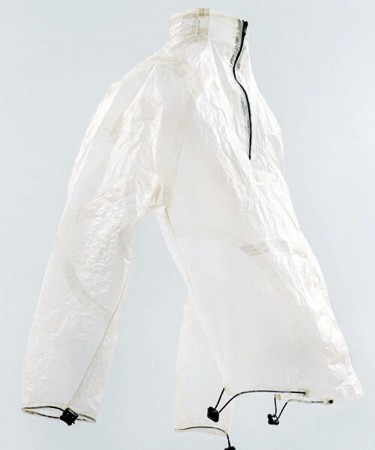
Berlin-based design and research firm WINT Design Lab envisions, prototypes and designs regenerative futures through devices and biotextiles that allow humans to connect with their bodies more, and free themselves from fossil materials that harm them and the environment. The industry currently produces materials that run almost entirely on fossil fuels, but the design lab believes the timeline for using these materials is getting shorter.
Their projects use touch instead of screens, biological materials instead of petroleum-based ones, and technology that adapts to the person rather than demanding the person adapt to it. The studio’s designs live as infrastructures that can connect us more to our physical and sensorial sides, with the help of biosensors, physiotherapy devices, inflatable structures, bio-based textiles, and even robotic paper folding.
The thread that connects the studio’s creations so far is a belief that the materials and objects closest to the human body should work with it, not against it. A direct expression of this is AVA, a wearable physiotherapy device developed with CPI Electronics and funded by the European Commission’s Horizon 2020 initiative.
People recovering from muscle, ligament or bone injuries are often sent home with exercises to do, but without supervision. If they do them wrong, recovery can slow down, so the treatment extends. AVA is a compact device that attaches to any body part and uses embedded machine learning to recognize whether a movement is being performed correctly, then gives the user a vibrotactile signal, or a physical pulse, to confirm or correct.
There is no screen or app involved to use it, as the therapist trains the device through movement, all the while the patient uses their body, and the device communicates through touch. In a community where healthcare is distributed and accessible rather than centralized and expensive, this is what primary rehabilitation can look like: quiet, portable, and entirely focused on the person doing the recovering.
WINT Design Lab also shifts from how objects feel to what they are made of and where they go after use. GOLD, the collagen-based textile project developed with Mimotype, built a demonstrator jacket from cow gut tissue using robotic yarn laying and lamination, which is a biodegradable material separable from fiber composites without chemical toxins and acts as a waterproof outer layer for Arctic conditions.