 TEXTILES.ORG




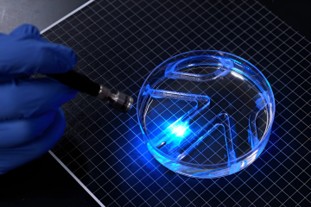
An MIT robot powered by a single layer of living muscle cells swam through a watery maze, following a light held in a researcher’s hand. It is slow, tiny and nowhere near ready for the open ocean, but its thin design could point toward softer, cheaper swimming machines.
The robot is about the size of a stick of chewing gum, with muscle cells attached to a flexible gel. The cells are genetically engineered to contract when light hits them. So if you shine a beam on one of its two fins, it beats. Alternate the light between them, and the robot turns as well as moves forward without the need for onboard electronics, so all the steering happens from outside the dish.
The fins measure 15 mm (0.59 in) long, 7 mm (0.28 in) wide and 0.5 mm (0.02 in) thick. “It takes a lot of force to move through water versus air,” says study author Ritu Raman, associate professor of mechanical engineering at MIT. “The robot’s quite strong, given its size.”
In the team’s earlier design, the very soft fibrin gel tended to wrinkle as the muscle cells pulled against it. The researchers switched to a stiffer gelatin-based gel and stamped square-bottomed grooves into its surface. Those grooves encouraged the cells to line up and fuse into fibers that could pull together more effectively.
The team also gave the muscle a workout, stimulating it with light for 15 minutes a day at two pulses per second. Compared with an unstimulated control group, that routine increased fin displacement fourfold. The muscle also kept working without being anchored for more than 30 days.
At its fastest, the robot traveled about four body lengths per minute. In the reported test, it moved and turned through a simple maze in a large Petri dish while a researcher guided it with a handheld light.
“We believe that biohybrid robots powered by living muscle could one day perform delicate jobs like exploring environments too fragile or unpredictable for conventional hardware, because living tissue is soft, responsive to its surroundings, and can heal itself,” Raman says.
Source: MIT