 TEXTILES.ORG




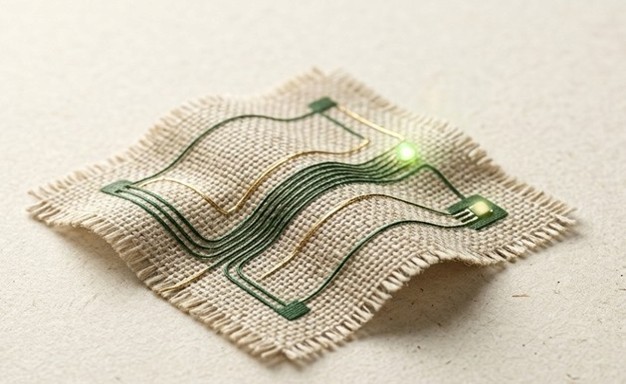
Textiles have evolved from being largely a fashion or comfort choice, to life-saving materials, thanks to growth in the advanced textiles sector. Advanced textiles have also become increasingly relevant due to climate and global political scenarios.
For example, inadequate school infrastructure, such as inefficient ventilation and insulation, have been among the complaints sparking recent protests in France. Currently in the U.S., data center expansion has become a bi-partisan issue in the forthcoming midterm elections in impacted areas of the country. In addition to their enormous size, data centers have a huge demand for air conditioning systems, which consume a great deal of energy.
Advanced textiles can play a significant role in addressing these issues, such as energy efficient air and water filters, climate friendly insulation, fluorescent textiles and comfort-rich clothing for the workforce in the new economy. Many of the products that cater to new economy requirements are either single use or semidurable. Due to the nature of these items, demand for these products will be higher than commodity and fast fashion items.
Such requirements create new opportunities for advanced textiles, as well as a semi-skilled and skilled workforce. By all accounts, the smart and advanced textiles sector are on course to show double digit growth.
Where are the developments?
Value addition and enabling active and passive functionality are what are making textiles “smarter.” Since the 1990s, wearables have been researched, discussed and developed, pushing steady growth in commercialization. However, there are challenges in the sector, including the need for understanding regulatory requirements, material compatibility, bio-suitability, safety and ease of use.
Sensor-enabled wearables have multiple applications, such as for wellness monitoring and medical interventions. This means that marketing claims must be carefully articulated to be appropriate to the level of risk. Normally, wearables that are meant for wellness, fitness and comfort need not be classified as medical devices, but categorization changes if the product claims medical intervention. There are complexities in understanding these regulations, and so regular educational and training programs are needed, much like those for medical professionals.
The industry should also focus on standards, both from product and application points of view. End-users, which may include medical practitioners, emergency personnel, warfighters, fire fighters and other consumers should be involved in developing standards. Textile industry associations, such as the American Association of Textile Chemists and Colorists (AATCC) and global standardization organizations such as ISO and ASTM International, have more recently been engaging in standards development in areas such as the washability of wearables and microplastics shedding.
These organizations are well established in developing standards for the benefit of manufacturers and end-users. However, for electronics embedded textiles, acceptance and applicability arise only when practitioners in other markets, such as emergency preparedness and medical fields, become engaged. Technical and marketing personnel would benefit from training related to FDA regulations, and industry associations should conduct regular training workshops to disseminate information regarding these regulations.
Multidisciplinary product development
Recently innovative approaches have evolved which not only involve electronics, but utilize metals, minerals and new materials like graphene. 2D thin carbon graphene has unique thermal and electron transfer capability, which can be beneficial in products for filtration, thermal regulation, high-strength applications and others.
The European Union’s Horizon Europe program has launched a four-year effort on Transformational e-Textiles, “e-Flower,” a ~€5 million, 4-year project that aims to develop the next generation of eco-designed, conformable, and sustainable e-textiles, embedding Safe and Sustainable by Design (SSbD) principles from the very beginning.
The project, launched in April 2026, is coordinated by the Tyndall National Institute at University College Cork, Ireland. It aims to develop stretchable – and circular – electronic textiles. The aim is to use a combinatorial approach using material technologies and electronics to develop safety garments, fitness clothing for astronauts, as well as sportswear for consumers generally.
Graphene’s thermal properties are being manipulated to control infrared transmission to in turn control body temperature and prevent energy loss. Scientists led by Professor Coskun Kocobas at the University of Manchester, U.K. have been harnessing the properties of graphene to develop adaptive space suits. The team has been successful in developing thermal camouflage that can mask infrared cameras, and graphene embedded with cotton that can read signals invisible to the naked eye.
Collaborative research in the U.K., led by the University of Southampton, uses inkjet-printed graphene on textiles to increase biodegradability. Based on soil burial tests, these smart textiles have an environmental load 40 times less, compared with typical electronic wearables.
Industry has focused heavily on incorporating graphene into wovens. As nonwovens are highly porous, incorporating porous graphene will lead to filters that can filter heavy metals and salts. Filtration with graphene is a burgeoning field that should be explored further.
Nottingham Trent University (NTU) conducting multiple projects involving electronic textiles. With funding from Cancer Research UK, Prof. Yang Wei is developing a bra that can detect cancerous tissues.
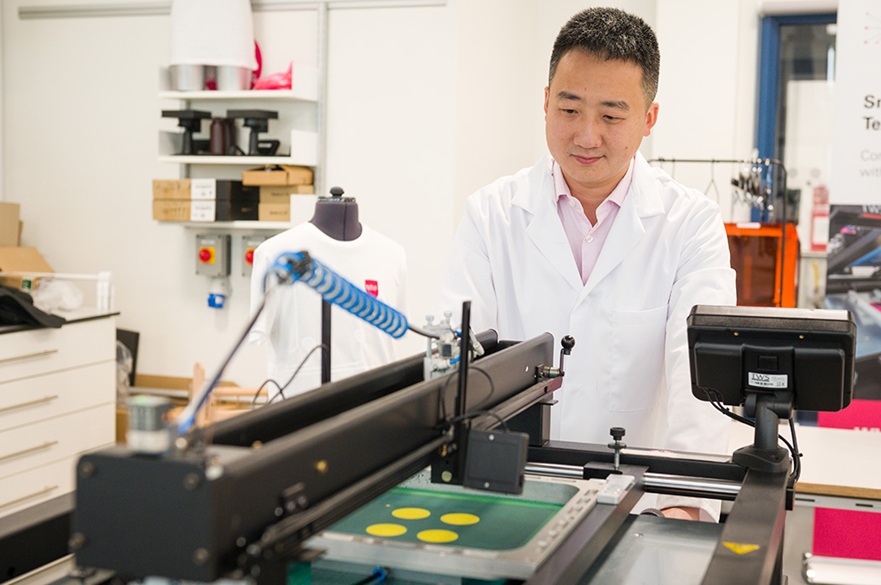
Cancer tissues are denser than normal tissues which are reflected in signal variations in communication devices. Interesting projects have emerged, such as a printed sensing wound dressings that can monitor healing, haptic sensor-activated pillows for seniors and the hearing impaired are being explored at NTU.
Exciting possibilities
Research in Dr. Julia Shamshina’s laboratory at the Fiber and Biopolymer Research Institute (FBRI), Texas Tech University, Lubbock, focuses on the use of nanochitin as a sustainable reinforcing material for polymer films, with potential applications in advanced and functional textiles.
The research effort compared chitin nanowhiskers and chitin nanofibrils at different concentrations and demonstrated that lesser amounts of nanochitin can improve polymer-level performance. According to Dr. Shamshina adding only 0.1 wt. chitin nanofibrils increased the tensile strength of plasticized nylon-6 films by approximately 2.5 times compared with the unreinforced polymer.
“These findings highlight the potential of biobased nanomaterials to improve the performance of synthetic polymers while reducing the amount of reinforcing material required. Although our current research focuses on polymer films rather than finished textiles, the underlying principles of nanochitin–polymer interactions could be relevant to the development of sustainable textile coatings, composite fibers and other advanced textile materials,” Dr. Shamshina says.
Research also investigated different approaches to isolate chitin from edible mushrooms and subsequently processed the recovered biopolymer into continuous fibers using jet extrusion. The mechanical properties of mushroom-derived fibers were comparable to those of fibers produced from conventional chitin. According to researchers, the findings demonstrate the feasibility of transforming mushroom biomass into continuous biopolymer fibers, offering an alternative to animal-derived chitin and opening opportunities for additional sustainable, biobased textile materials. Their successful fabrication provides a promising foundation for future functional textile applications.
Thomas Jefferson University has been working on color-changing textiles since 2016. Anna Grimes, Ph.D. student in Textile Engineering & Science, and Brian George, Ph.D., the director of Graduate Technical Textile Programs, provided an overview of ongoing projects at Thomas Jefferson University. One project focused on thermochromic fabrics which changed color based on user temperature.
The researchers believe these smart textiles could be useful in hospitals, where incoming patients could be provided with a mask, and if the mask changed colors, indicative of a fever, hospital staff would be able to diagnose it and isolate the patient.
Another project, resulting in a patent, focused on persistent luminescent textiles which would exhibit a glow under UV light. Such a material could be effective at finding lost sailors, hikers or hunters wearing garments made with these materials in a low light environment, by using UV lights.
An additional project focuses on electrochromic textiles, which could change from one color to another and back again using low voltage. According to the researchers, electrochromic smart textiles are useful in a variety of applications (such as in fashion) where a garment’s color could be changed depending on the look the user wants at that time.
While much work has been done on synthetics, the above projects highlight the growing interest in natural fibers and composites for developing advanced textiles. “Natural fibers like cotton can provide both a foundation for smart textiles and, through recycling, a cellulose feedstock for new fibers, films, and functional coatings,” says Assoc. Prof. Brendan Kelly, who runs the Cotton Phenomics Laboratory at the Fiber and Biopolymer Research Institute (FBRI) in Texas Tech’s Department of Plant and Soil Science. Kelly, who also specializes in recycling, adds, “To me, a truly smart textile is one designed so we can recover those valuable materials and use them again.”
What to expect
Developments in sensors, wireless communication, information technology, artificial intelligence, knowledge base systems, and materials technology can be employed to develop next-generation advanced textiles. Unlike conventional textiles, growth in smart textiles comes from new products and applications. That means this field normally does not demand huge machinery investments like those in spinning and finishing. Woven, knits and nonwoven structures can be used with components like electronics, minerals and metals to develop a myriad of products that can find applications in defense and health care. These aspects are advantageous for smart and industrial textiles.
The next-generation textile sector is dependent on human knowledge and skill and hence efforts should be on skill development, knowledge creation and dissemination. Like custom-made products for high-end fashion and medical applications, smart textiles will soon be based on individual requirements and application needs. Development of such products will boost entrepreneurship and help small and medium scale industry. It is evident that the advanced textiles sector will be a job-creating industry.
Dr. Seshadri Ramkumar is a professor in the Department of Environmental Toxicology and The Institute of Environmental and Human Health, Texas Tech University, and a regular contributor to Textile Technology Source.