 TEXTILES.ORG




The medical, defense and protective textiles (MDP) are market segments within advanced textiles which show promise even when stressful situations, such as war and natural calamities, dominate our attention. It is ironic that during challenging times prices of commodity products are in high demand, and, interestingly, the growing demand for life-saving products seems to be immune to the rise and volatility in oil prices. Observers agree that the growth of these sectors is 2-3 times that of economic growth, generally.
Market predictions
Authoritative agencies, such as the International Monetary Fund (IMF), the global policy forum, the Organization for Economic Cooperation and Development (OECD), and the World Bank offer reliable estimates on the growth of specific industries, as well as global and regional economic forecasts. The April 2026 global forecast by IMF takes the current war into account and is a good benchmark to forecast the growth of the advanced materials industry, and importantly, offers a conservative assessment of the MDP sector.
According to the IMF, in the next two years, global growth is expected to be slower compared to 2024–25, forecast to be at 3.1 percent in 2026 and 3.2 percent in 2027. Taking these figures as base points, we predict the growth of medical textiles globally to be about 6–7 percent. However, the growth will be more in the South and Southeast Asia regions, due to population growth, income level rise and government investments there.
Efforts by the Indian government must be recognized with its National Technical Textiles, an initiative launched in 2020 to promote research, innovation and domestic manufacturing of technical textiles. India has set a growth target of about 15–20 percent for the technical textiles sector. A Centre of Excellence in Medical Textiles has been established with initial government support in Coimbatore at the South India Textile Research Association to boost R&D and support marketing efforts.
As the headline inflation is expected to be 4.4 percent in 2026 and 3.7 percent in 2027, demand in consumer and consumer-related hygiene products may slow down. But, given the war situation in two major regions of the world, demand for implantable and hospital-use medical products will increase. Thus, forecasts indicate growth in medical and high-performance materials.

Growth and the geopolitical scenario
The economy is an indicator of consumer demand and investment opportunities. Both low-end commodity and high-end medical products will have markets with varying margins. Mass-produced hospital textiles will be needed, and there will be an uptick in usage in Asia, the Middle East, and Eastern Europe.
The raw materials for these products are light to medium (7 to 15 GSM) spunmelt nonwovens. China and India have the capacity to meet requirements with recent investments in multibeam line production, such as that used by Global Nonwovens in India. These countries have converting expertise and hence will be able to manufacture end-use products with acceptable margins.
Hospital in-use and personal care products will spearhead the growth of the advanced textiles sector in developing economies. Implantable and advanced medical textiles, along with textiles that have dual application, such as medical and protection; sustainable textiles for healthcare; products with microbial protection and comfort; functional medical textiles and wearables. These are functionalities that can lead the growth of medical textiles in the U.S. and Europe.
Functionalized hybrid structures
Developments in fabric structures coupled with chemical applications can result in functionalized hybrid fabrics for applications in healthcare, aerospace, defense and environmental protection. Research carried out in Professor Vinoy Thomas’ laboratory at the University of Alabama at Birmingham has resulted in fabric structures which provide cooler fabrics compared to regular fabrics.
The process uses low-pressure plasma functionalized with tetraethoxy orthosilicate (TEOS). The presence of nanofibers in the basic fabric structure such as woven creates a plasma-induced silane nanolayer that can reflect IR rays. When IR rays are reflected, the temperature of substrates comes down, enabling a cooler environment. According to researchers, plasma-processed nano, soft composite structures seem to be 15°C cooler than untreated fabrics. This research has opened new opportunities for sustainable hybrid fabrics with functional characteristics.
A good example of hybrid methodology/manufacturing is Conover, N.C.-based Supreme Corp.’s, HEAL smart yarns that utilize electrical energy aspects, materials engineering, and textile manufacture in producing functional yarns with medicinal values that can promote healing. In medical application, it’s a photosensitizer-based therapy which utilizes energy to sensitize a dye-nano particle hybrid product. An interesting aspect of technology is that functionalization happens due to heat generated from the body and its effect on photosensitive dyes and catalytic nanoparticles.
The addition of nanoparticles helps with catalysis, enabling efficient energy absorption and energy transfer on the human body, enabling medicinal advantages. Dyes, proprietary nano particles, and additives are coated to the yarns, and the technology enables durability by techniques, such as heat setting, enabling the functional yarns to be knitted into socks and fabrics to provide enhanced blood circulation and therapeutic functions.
“Textiles in the biomedical field are evolving from passive materials to active functional systems. Engineered structures create high surface-area interfaces, inspired by self-assembly processes observed in nature, increasing how effectively the fibers interact with the body. Rather than being passive, the material is designed to engage with the body’s natural thermal environment, enabling more efficient thermal exchange and supporting overall comfort and recovery,” says Rakkiyappan Chandran, scientific advisor, Supreme Corp.
Recent results on photosensitive dye-treated nylon knit showed a 10.5 percent increase in muscle oxygenation (SmO₂) within eight minutes. “The effect is achieved through material engineering at the yarn and fabric level, using either nanoparticle integration or advanced manufacturing methods to support the textile’s therapeutic function,” says Matthew Kolmes, Supreme Corp. CEO.
“Innovation in biomedical textiles happens at the intersections, where advanced fibers meet functional nanoparticles. We’re moving beyond passive materials and creating fabrics that actively participate in healing, protection and human performance,” says Kolmes.
A hybrid process for medical decontamination
Like hybrid products, hybrid technology is gaining recognition in delivering medical advantages in emergency scenarios and lifesaving applications. In recent months, FiberTect nonwoven soft composite, which was invented for defense applications, has been found to also be useful in medical countermeasures, such as cleaning up opioid microparticles.
The opioid crisis has been a consistent problem in the U.S. Fredericksburg-based First Line Technology offers a Personal Decon Kit (First Line PDK) which employs hybrid products, i.e., a textile wipe and chemical formulation.
According to First Line Technology, the kit contains two FiberTect wipes, Dahlgren Decon solution, and a small sprayer, all contained in a resealable plastic bag. The application is also streamlined using three steps:
- The FiberTect wipe is used to blot and wipe the surfaces to collect and remove any fentanyl powder residue, then placed in the bag and sealed.
- Dahlgren Decon solution is sprayed onto the same surface and allowed to sit for five minutes. This chemically converts any residual fentanyl into a safe and non-regulated substance
- The second FiberTect wipe is used to absorb the residual liquid containing the detoxified fentanyl.
“Numerous agencies are using the First Line PDK as a standard response for dealing with fentanyl contamination on surfaces. This PDK kit is issued to every police officer in many jurisdictions,” says Corey Collings, director of technical and training at First Line Technology.
Wearables in the medical field
Wearable textile technologies have seen incremental development since the advent of the Smart Shirt from the Georgia Institute of Technology; wearables in the medical field specifically are finding acceptance as diagnostic and analytical tools.
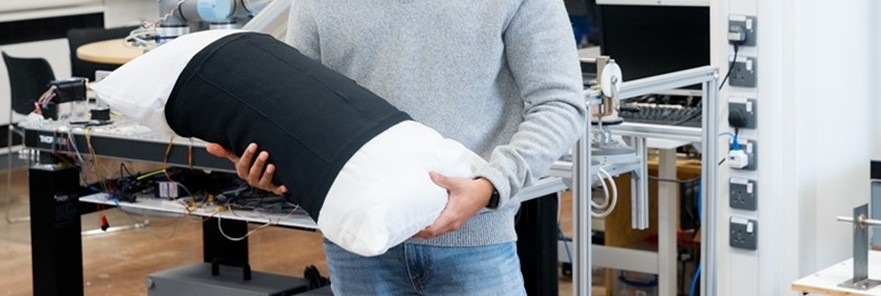
U.K.-based Nottingham Trent University has this month announced a smart pillow cover which can sense and alert the user of alarms activated due to fire, burglary or another danger. The work was part of the doctoral research of Malindu Ehelagasthenna, under the supervision of Dr. Theo Hughes-Riley. Tiny electronics, such as haptic actuators, are embedded into yarns which make up the fabric; the electronic circuit is wirelessly connected to fire and burglar alarms or phones.
When the alarms are activated, the haptic actuator electronics creates vibrations which can be felt by those with a physical challenge, such as hearing loss. The work evolved out of a collaboration with user communities involving multiple disciplines, including electronics and communication, textiles, and design.
In another project, tiny thermistors are embedded into yarns that are used in manufacturing vests. The vest, with the help of the thermistors, can detect changes in body temperature. The electronics in the vest are wirelessly connected to the smart phone of the caregiver of the elderly person or and patient. According to researchers, the electronics embedded vests are durable as they are encapsulated in resins and, due to a thin profile and light weight, they are also comfortable.
Medical textiles can utilize hybrid materials and processes to provide signal-sensing functionality, as seen in these products developed at Nottingham Trent University’s Advanced Textiles Research Group. Wide-scale applicability, cost, reliability, and durability are some of the challenges that still need solutions. In addition to functional attributes, washability and durability are practical challenges to be addressed.
Implantable textiles and manufacturing
Polymers are the base materials for 3D printing of a range of materials and products, including non-resorbable implantable polymers such as Poly Ether Ether Ketone (PEEK), Poly Ether Ketone Ketone (PEKK), and others; and resorbable implantable polymers, such as poly(ε-caprolactone) (PCL).
Dr. Jayanthi Parthasarathy, manager, 3D Printing, Dept. of Radiology, Nationwide Children’s Hospital, Columbus, Ohio, says that 3D printing has been shown to be an efficient method of manufacturing human parts with lattice structures. This makes it possible to create implants with engineered material properties to match the region of implantation.
The process allows for production of an implant with various properties, such as a smooth surface in a joint area, or a lattice pattern in a region for bone ingrowth, Parthasarathy says. Patients treated with such implants are seen to have less chance of infection, faster recovery and good cosmesis.
Polymeric materials that are used for developing implantable materials are well established. The next phase of research and development involves agile and advanced manufacturing of sustainable products for implantation into surgical and anatomical teaching. There is a long way to go in this field, but it is worth looking into new avenues.
Emerging areas
“Textiles and nonwovens are poised to play a defining role in next-generation wound care because they can be engineered not just as passive covers, but as functional healing platforms,” says Dr. Gaurav Pranami, VP, research and development, at Wisconsin-based medical device company Imbed Biosciences Inc.
“Advanced fibrous matrices can manage moisture, protect fragile tissue, and deliver antimicrobial or other bioactive cues that create a more favorable healing environment. Their real promise is to combine therapeutic function with scalable manufacturability,” Pranami says.
With awareness increasing on the harmful effects of some synthetic ingredients, Chennai, India-based Asthagiri Herbal Research Foundation is pioneering research in herbal formulations for textile products. Research focuses on using non-alcoholic herbal disinfectants for in-situ control of microbes.
Natural herbs such as citrus limon, citrus aurantifolia and Krimighna are among the list of ingredients available in Ayurvedic literature. Such formulations can be applied to fabrics and filters making them sustainable, while not compromising functional properties.
Where are the advances?
Given the necessity of medical products and geopolitical conflicts, there will be growth in developing composite and hybrid fabric structures, chemical formulations, modular design structures and converted products. Based on data from multiple market analysis firms, textiles used in medical, defense and hygiene areas may have growth twice that of GDP of respective regions. Currently, global medical textiles are growing at about 5-6 percent, which is nearly twice that of global GDP growth.
The functional aspects of medical textiles are now well established and large manufacturing supply chains are also well established. To avoid disruption of supply chains, as was the case during the COVID-19 pandemic, industry and related industry associations should lobby for government support for strengthening the domestic industry. The use of sustainable materials and manufacturing processes, as well as maintaining comfort without sacrificing barrier properties and higher quality, must be the focus. This is the next phase of R&D.
An immediate need for the industry is R&D on alternate materials for restricted products. Industry and academia are focusing on alternates to forever chemicals, but these also need government support. In addition to the need for increased research and entrepreneurship support from government, the time needed for approval in regulatory processes need to be streamlined, but without sacrificing safety.
The technical textiles industry in general has growth prospects and within this sector, the medical textiles industry is a growing sector, even in developed economies—which have an edge in innovations in this field—while manufacturing needs strengthening. Growing economies like India’s have also recognized the need and economic vitality of medical textiles.
Dr. Seshadri Ramkumar is a professor in the Department of Environmental Toxicology and The Institute of Environmental and Human Health, Texas Tech University, and a regular contributor to Textile Technology Source.