 TEXTILES.ORG




Editor’s note: This feature is the second part of a two-part article by this writer on the topic of natural fibers in advanced textile materials and products. Part I focused on cotton and wool; This article discusses bast fiber: plant-based fibers that grow within the stems of certain plants.
According to textilelearner.net, the fibers are those located in the inner bark, or phloem layer, of the stalk, and can reach several feet in length. They play an important role in the textile industry. Most come from plants cultivated in agriculture—flax, ramie, jute, kenaf and hemp. They are generally thick and boast high tensile strength and are often processed for use in coarse textiles such as ropes, carpet yarn, traditional carpets, geotextiles, or burlap sack, but can also be used in a variety of composites. – jp
Bast fibers poised for growth
The bast fibers—hemp, flax, jute and ramie—have a long history of usefulness in apparel and industrial textiles. Easy to grow but difficult to process, they are eco-friendly and biodegradable, requiring less water and fewer pesticides, sequestering CO2 and promoting soil remediation. They are also strong, absorbent, breathable and non-toxic.
An excellent insulator, hemp is the perfect alternative to fossil fuel-based polymers; it’s anti-microbial, and resistant to mold, mildew, and UV radiation. But for decades following the 1937 Marijuana Tax Act, growing and processing industrial hemp in the United States was illegal.
Finally recognizing that hemp contains only very low levels of the psychoactive compound THC, the U.S. government legalized the cultivation of industrial hemp under the 2018 Farm Bill.
While the infrastructure for growing, processing, and marketing hemp fiber in the U.S. is making a slow but steady comeback, the current administration has passed a law that will reclassify and regulate hemp-derived products used in consumables.
“Regulatory red tape has buried our industry in ambiguity,” points out Morgan Tweet, CEO of IND HEMP, a leader in supplying high-quality hemp products for textiles. Tweet is an advocate for the National Hemp Association, and in her YouTube “Message to the President,” she implores “We must establish a distinct regulatory framework for true industrial hemp.”
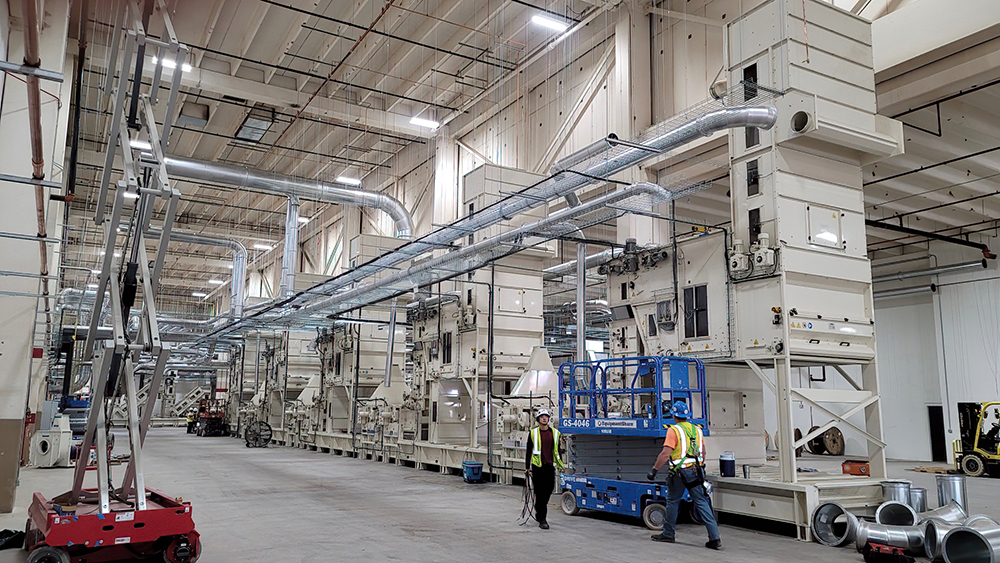
Montana-based IND HEMP supports local farmers in hemp agriculture, and processes hemp oil and seed for food products alongside its fiber for textiles. Its 52,000 sq. ft. decortication facility can process flax fiber as well as hemp at the rate of five tons per hour.

IND HEMP mechanically cleans and processes the bast fiber to various degrees, depending on end-use specifications. The hurd is cleaned, chopped and milled into particulates to be used in molding, extrusion and composite products, or in hempcrete for buildings.
Texas-based Panda Biotech is also at the forefront of the made-in-America hemp renaissance. The 500,000 sq.ft. Panda Hemp Gin, capable of processing 22,000 lbs. of hemp straw per hour, opened in Wichita Falls in 2024 in an equity partnership with the Southern Ute Indian Tribe.
Using American-grown feedstock, Panda produces premium textile-grade and nonwoven-grade fiber via a proprietary decortication technology. With a focus on cottonized hemp fiber that has successfully run on existing spinning systems around the world, Panda also processes hurd, micronized hemp, and short-fiber/hurd mix designed to serve a wide range of textiles, construction, bioplastics, transportation and non-wovens.
Hemp fibers are increasingly utilized across industries such as apparel and automotive textiles, insulation, building construction, and medical and personal care. Cottonization, a relatively new process, makes it suitable for spinning into textile yarns or spunlace nonwovens for wipes and hygienic products; and the ability to drop hemp fiber into cotton spinning systems clears a major hurdle.
“We’re operating in a world where textiles are expected to do more than ever before—perform better, last longer, and meet higher environmental standards,” points out Dixie Carter, Panda Biotech’s president. “Natural fibers like hemp are uniquely positioned to meet that moment. They offer a rare combination of technical capability and environmental responsibility, and with unique cottonization processes like the ones we have perfected at Panda, they can integrate seamlessly into even the most advanced textile applications.”
Hemp’s global reach
China, India, the U.S., Canada and the Netherlands are currently the leaders in the production of industrial hemp, with China producing some 70 percent of the world’s hemp fabric. According to Grand View Research, the global hemp fiber market size was estimated at $379.5 million in 2024 and is projected to reach $1990 million by 2033, growing at a CAGR of 20.4 percent from 2025 to 2033. Decorticated American hemp fiber is in demand by textile manufacturers in Asia.
“We are at the beginning of a materials transition, and hemp fiber belongs at the center of it—from the clothes we wear to the vehicles we drive. True industrial hemp—fiber and grain—for textiles, food and feed, bioplastics, constructions, fuels, paper and packaging represent a $15 trillion opportunity,” says Geoff Whaling, chairman of the National Hemp Association. “The question is not whether hemp has a role to play, but whether Congress will move fast enough to capture it.”
Beyond linen: technical flax
While flax has long been cultivated for linen, particularly in Europe, a Swiss company called Bcomp Ltd. is exploiting its technical side. The company has become a leader in natural fiber composites for sustainable lightweighting in the mobility markets.
“Natural fiber composites are the high-performance engineering material of a future that favors circular solutions without compromising performance,” according to the company’s website.

Bcomp’s ampliTex™ technical fabrics and powerRibs™ reinforcements replace plastic-based and carbon fiber components in automobiles, mass transportation applications, boats, recreational equipment, and large infrastructure, with CO2-neutral composites made from European flax. In the automotive sector they are partnering with Polestar, Porsche, Kia Corp. and BMW Group.
Bcomp and BMW Group’s collaboration, “BMW M Natural Fiber Composites,” won first prize in the category “Automotive & Road Transportation – Parts” at the 2026 JEC Composites Innovation Awards. In a press release, Bcomp’s CEO Christian Fischer said, “This milestone marks the largest real-world application of high-performance renewable composites in the automotive industry; it demonstrates that natural fiber composites are ready for large-scale premium automotive applications.”
While the use of natural fibers in technical and performance textiles currently comes at a price, growth of the supply chain and manufacturing infrastructure could see improved price parity with synthetics, especially if current disruption in the oil market continues. Natural fibers offer a sustainable alternative.
Debra Cobb is a freelance writer with expertise in the textile industry. She is based in Greensboro, N.C.