 TEXTILES.ORG




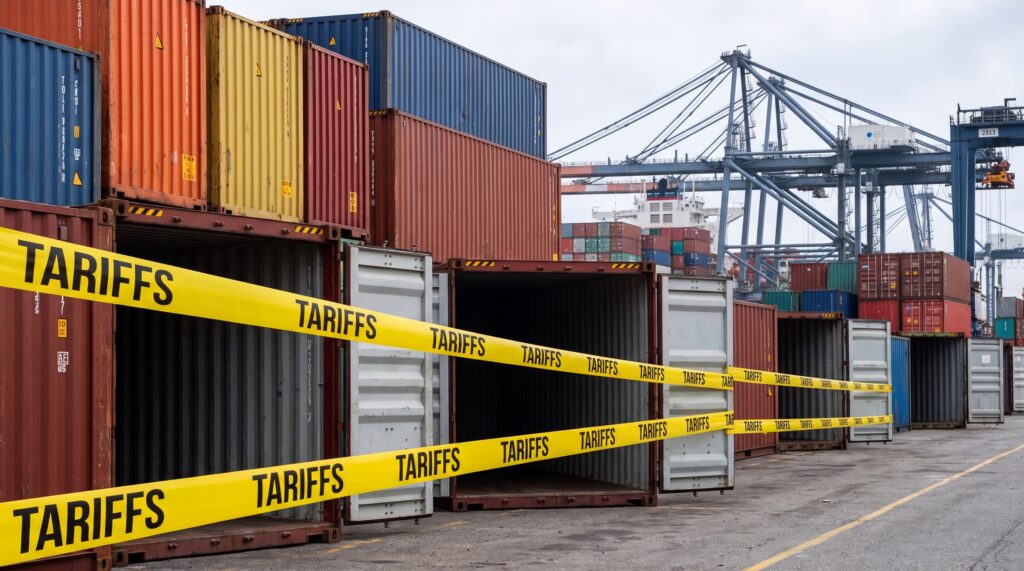
Editor’s note: The current administration’s trade decisions, including tariffs, have had a significant impact on the textile industry. I asked Kimberly Glas, National Council of Textile Organizations (NCTO) president and CEO, to offer the organization’s perspective on the current trade situation.
For example, earlier this summer, CNBC.com reported that the U.S. proposed tariffs of up to 12.5 percent on imports from 60 economies for failing to ban forced labor goods. Economies with partial forced labor bans face a 10 percent duty. “The move marks a major step in Trump’s push to reinstate his country-specific tariffs that were mostly struck down,” the report said. This went into effect Sept. 1.
But the situation is, in fact, so dynamic that dramatic changes have occurred just since this interview was conducted on August 18. President Trump announced a 50 percent tariff on a range of Canadian goods, which sparked retaliatory tariffs, upwards of $20 billion, from Canada, effective September 8.
In this first of a two-part article, Glas lays out important background information and first-hand knowledge of how industry participants are finding ways to navigate an ever-changing global trade landscape. Look for Part II of this interview September 30 on this site. It will continue this discussion and share how NCTO and others are committed to working with the administration to address and resolve key issues, including ongoing enforcement weaknesses, as well as the unintended repercussions from tariff decisions. – jp
Q: It would be useful to look at the larger picture, I think. Where do we begin?
Glas: I’ll give you a little context. We’re living in a dynamic time for the U.S. textile industry. The velocity of change that is facing the industry is, at times, completely overwhelming. We have lost 43 U.S. textile operations — all highly automated, highly sophisticated and globally competitive — over the last two years, and there’s a confluence of things all happening at once that is creating this kind of pressure in the system.
We have uncertainty associated with trade policy, with different tariff regimes and how countries are responding to tariffs, which includes subsidizing their own industries, keeping their own people employed. This is leading to below-cost products flooding the U.S. market, or through other markets, through illegal transshipment.
We also have worker shortages here in the United States, generally, with fewer students going into manufacturing, [among other pertinent areas]. For some in our industry, they’re running anywhere between 50 and 70 percent capacity.
This industry prides itself on being globally competitive, and to achieve that, it needs to constantly reinvest in automation and technology and innovation. But when you have a confluence of all these things happening all at once, it puts significant strain on the industry and the supply chain. And we have a small-yet-mighty and important textile industry that has to closely collaborate in order to thrive and in some cases survive.
So, I think this particular environment has led to collaboration being even more important — figuring out new business opportunities, diversification, intelligence, about what’s working, what’s not working, adaptation and the supply chain, in order for all of us to not only weather the storm but hopefully come out on the other side of it stronger as an industry as a whole. This gives you a sense of the myriad issues facing the industry right now, in an unprecedented time.
Q: I’ve been putting things together from pieces, but you’re right in the middle of it, specifically. So, what I suspected, you’ve not just confirmed, but given me details — plant closures, the difficulty with worker shortages. So, my next question would simply be that they have to collaborate more to survive, and thrive, but how? Also, what, specifically, are companies doing that’s working, given the challenges they face?
Glas: Right, yeah. I’ve made a point of reaching out to all NCTO members. So, I represent 160 domestic companies, and over the last year I have had hour-long or half-hour-long conversations, with each and every company. You can get a lot of granularity about what’s facing that specific company and the themes were all very consistent.
Of the companies that I talked to that are seeing growth opportunities, it may have been in a different segment, like more high tech, industrial, or building new markets. A lot of companies, when you’re in a storm, like we’re in right now, all have to be evaluating what’s working, what’s not working, and also, how to diversify. So their thinking goes like this: “In my company, through the ebbs and flows of what’s happening in the consumer marketplace, there’s always a segment that I’m working on that’s growing.”
And what are those growth opportunities? We’ve seen some industry participants pivot to the non-wovens industry, right? Because that’s a growing industry in the U.S. and the import competition, while still there, is somewhat protected based on the kinds of products manufactured and the speed-to-market close proximity for certain kinds of items.
You’re seeing companies diversify in what they’re offering the military — not just uniforms, but more technical textiles, things like that, that they can also sell in the commercial marketplace. There’s never any one formula, where I hear somebody saying, “Okay, everyone needs to be pivoting exactly like this company.”
It’s usually a combination of assessing a company’s competencies, what are the biggest growth opportunities, and where are opportunities that may no longer be that same level of growth. “Is this the new normal?” That’s the question I get a lot on the phone from companies.
Since we’ve come out of COVID, when we had the industry mostly shut down with the exception of PPE, consumers started going back shopping and the economy started rolling again, and the demand was huge. We couldn’t make enough yarn. We couldn’t make enough fabric. Then that ended up plummeting pretty significantly as inventories built up, because customers were asking everybody for products and the orders came in all at once. It took two years or so to get through all that inventory that had built up, leading to depressed demand in the U.S.
Then you had a confluence of tariff policy and other things coming out of Washington that created a level of uncertainty. We had uncertainty when the administration first started on whether or not we’d preserve USMCA (United States–Mexico–Canada Agreement). Our top export destinations are Canada and Mexico, so that led to consternation. We had tariffs threatened on Mexico. We had tariffs on our exports markets in Central America.
Then we had tariffs imposed under the IEEPA [International Emergency Economic Powers Act], which the Supreme Court subsequently struck down. Now we have forced labor tariffs. We likely will have excess capacity tariffs. Questions the industry is raising include: How do I adapt in an environment that is ever changing and evolving, and also, how should I invest? Because I don’t know what’s going to be coming out next, that doesn’t provide me certainty.
There’s generally a sense that there’s always risk to any investment. But in an environment that is constantly evolving – and the ground is shifting so quickly — it’s very hard for companies right now, to say, yes, I’m going to take the biggest risk: a whole different paradigm for my company. I think they’re just trying to navigate these waters right now and see what the “terrain” looks like moving ahead.
Q: Given that, a company is kind of stuck between a rock and a hard place. You have to take risks, but it’s especially hard to take risks right now, specifically because of these uncertainties. So, it seems to me the one thing everybody craves is information they can count on. Am I, right?
Glas: That’s right.
Q: So, where do they go?
Glas: That’s the hard part. What is the information we’re counting on, you know, that may not change next week? Even if you talk to machinery companies, and it’s worth calling our machinery guys who service the U.S. We don’t make textile machinery here, or we make very little, but you’ll see that there haven’t been a lot of orders placed.
Why? Well, that machinery has gotten so much more expensive to purchase here in the U.S. because of penalty tariffs on the machinery that would help us reinvest in our U.S. manufacturing. Yet other countries don’t have those same penalty tariffs applied. So, it’s easier to offshore our production to other countries to mitigate costs. I don’t think the administration’s intent at all is to offshore industry. It’s the intent of the administration to onshore it. But I think there are ways of doing this that would lead to that outcome.
It’s kind of a unique moment in time in our industry; often we like tariffs, generally, as a way to protect from predatory trade behaviors. But we also know a lot of importers don’t like tariffs. They’ve never seen a tariff they like. But this environment has also led to collaborations, as well, between our industry and the importing community, for the first time, to see if we could develop policy options that the administration could consider that would actually unlock more business, giving importers rewards for buying more that is manufactured here in the U.S.
We worked with brands and retailers to develop a joint onshoring proposal that we have proposed to the administration and that would allow importers to use tariff credits, applying to certain designated countries to import other product — so that the more they buy here, the more offsets that they would earn. It’s led to sort of unique thinking, I think, across our industry of how to navigate this period of time. This proposal, if adopted, could easily stabilize our industry and double its growth. We need the administration’s support.
Q: So, it’s not that clear-cut with tariffs. We think, “Well, you’re going to have to pay more, or we’re going to benefit from that,” but it’s not that simple.
GLAS: That’s right.
Q: But the way you’re describing it to me here is that there are workarounds, right?
GLAS: Yes, but first, I think if tariffs had been consistently applied and strategic — on things that were coming in that harm the industry versus on machinery, which we need to manufacture — I think you could see some results. If we knew that these tariffs are in effect for X period of time, I think that gives certainty to a lot of folks — buyers, domestic industry and so forth, and you could see some potential growth. But because the tariff policy hasn’t unfolded that way.
We had the Supreme Court overturn the IEEPA tariffs. There’s new tariff policy almost weekly. Right now we’re about to face a 50 percent tariff on Canadian goods coming into the United States. Well, you know, our industry imports specialty fibers we don’t make here, and spin it into yarn, make it into fabric and export that to Mexico. What happens to that supply chain? All of a sudden Asia becomes cheaper — an even cheaper option.
So that’s what I’m saying. It’s so dynamic right now that people are, in real time, speed dialing each other [about] this is what’s going on with Canada, or this is what’s going on with Mexico today, trying to figure out alternative options in their supply chains that have been built and created around some of our free trade agreements.
Q: But then, it could change again or not, right?
GLAS: That’s correct. The one thing for certain is uncertainty.
Kim Glas is president & CEO at the National Council of Textile Organizations. Based in the Washington, D.C, area, she has extensive experience with government agencies and U.S. and international trade activities.
Janet Preus is senior editor of Textile Technology Source. She can be reached at janet.preus@textiles.org.