 TEXTILES.ORG




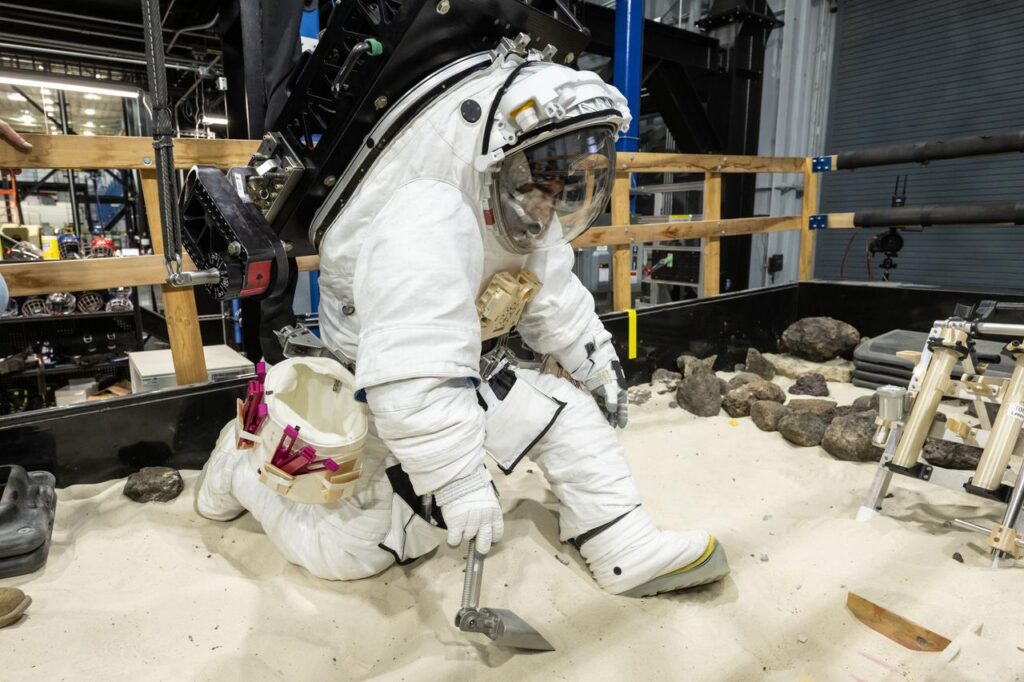
“Calendaring Spacesuit Fabric to Improve Dust Resistance,” presented by Bobby Jones, pressure garment engineer, NASA Johnson Space Center, discussed NASA’s ongoing effort to design, fabricate and test a new outer shell fabric for a lunar extravehicular activity (EVA) spacesuit for future missions to the Moon.
Jones, who is a part of the Artemis Suit Materials Team, discussed the primary challenge in designing spacesuit textiles: preventing the suit from being penetrated by lunar dust, which is highly abrasive and can potentially compromise suit durability and astronaut safety.
Jones’ team has explored calendaring as a potential low-cost, scalable method to enhance dust-blocking performance in certain fabrics. Calendaring is a continuous roll-to-roll mechanical finishing process in which fabric passes through heated rollers under high pressure to compress and flatten the weave, thereby reducing pore size and modifying surface texture without significantly affecting other properties.
Calendared Teflon T-162 and Ortho 116 fabric samples were tested. Researchers found that calendaring reduced dust penetration by approximately 99 percent in both fabrics. The Ortho 116 fabric experienced modest mechanical penalties, with a 15 percent reduction in puncture resistance, while the Teflon T-162 showed minimal mechanical impact, with a 5 percent reduction in tensile strength.
Future work will focus on vacuum electrostatic dust testing, thermal cycling, garment integration, seam/seal development, microstructural analysis, scale-up and process development and long-term durability testing.