 TEXTILES.ORG




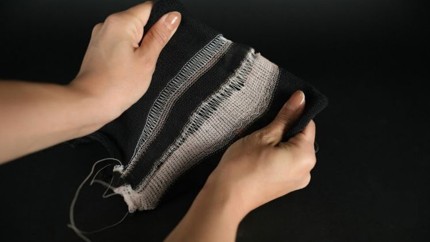
Researchers at the Harvard John A. Paulson School of Engineering and Applied Sciences (SEAS) have developed knitted fabrics that can switch between stable shapes, sense motion, and function as soft electrical switches, using the same weft-knitting machines already common in garment factories. The findings point toward a manufacturing-compatible route to programmable textiles.
The work was led by Kausalya Mahadevan, a recent SEAS Ph.D. graduate, now a postdoctoral associate in the lab of Katia Bertoldi, the William and Ami Kuan Danoff Professor of Applied Mechanics. The team set out to bring principles from nonlinear solid mechanics into textile design, an approach Mahadevan has described as combining insights from textile artists with her lab’s existing work on structural mechanics.
Most shape-holding textiles today are built by molding polymers and engineering residual stress into the material. The Harvard team instead relied on yarn selection and knitting structure alone. Using highly elastic yarns and a technique called plating, which places different yarns on opposite faces of the fabric, the researchers produced dense, thick knits that naturally curl into three-dimensional forms, the same mechanism that causes a cut T-shirt hem to roll upward.
By arranging horizontal and vertical knit stripes in systematic combinations, the team created fabrics capable of “snapping” between two or more stable configurations and holding each one, a property physicists term multistability, comparable to a switch that stays either on or off. The researchers mapped the geometric and material conditions that produce this behavior and validated their models by treating the knitted structure as a continuous material rather than simulating individual yarns.
Adding thin conductive yarns turned the knitted structures into soft, stretchable electrical switches that change state as the fabric snaps between shapes. Demonstrations included a knitted shell that switches an LED on and off as it moves between stable states; a wearable switch worn over a knee or elbow that can be read by an Arduino to count steps as the joint bends; and a reconfigurable lampshade in which three separate multi-stable switches each controlled a different light color as sections of the fabric were stretched.
Because the fabrics were produced on industrial-grade knitting machines similar to those already used in garment production, the researchers believe the technique could scale relatively quickly compared with polymer-molding approaches. The work also links textile engineering more closely to the broader field of nonlinear mechanical metamaterials — structures engineered to bend, buckle and snap in controlled, functional ways.
The research was supported by the U.S. National Science Foundation, the Army Research Office’s MURI [Multidisciplinary University Research Initiative] program, and an ONR [Office of Naval Research] DURIP [Defense University Research Instrumentation Program] equipment award.
Textile machinery base is built around weft and warp knitting at industrial scale, and the SEAS team’s central claim that multistability can be engineered through yarn choice and knit structure on existing equipment, without new tooling or polymer processing, thus lowering the barrier for domestic manufacturers to experiment with functional and smart textiles. As global sportswear, medtech and wearables brands look for suppliers who can move beyond flat, static knits, this kind of programmable-textile research is a signal worth tracking for Tier-1 knitwear manufacturers positioning themselves in technical and smart-fabric categories.