 TEXTILES.ORG




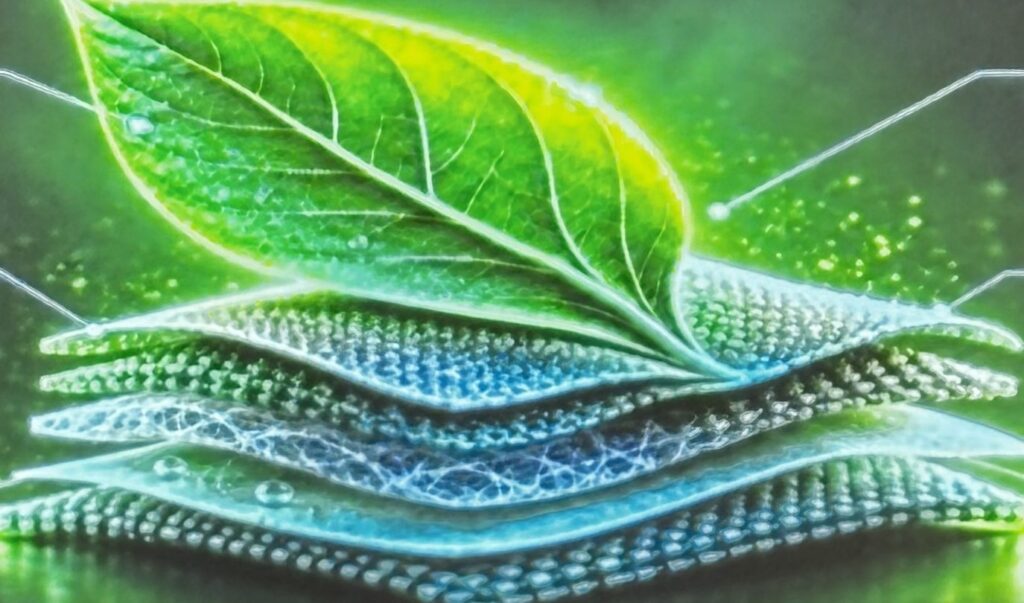
Biomimicry is, basically, the science of imitating nature to find solutions for human problems. Daryl L. Thompson, director of scientific initiatives at Global Research and Discovery Group (GRDG Sciences LLC), called plants “the original textile” in his talk about “lessons and applications for biomimicry” at the Advanced Textiles Association’s (ATA) Emerging Textiles (ET) Conference last week in Orlando, Fla.
Thompson explained how applying biomimicry in textile engineering could potentially solve a range of problems from preventing diseases carried by mosquitos, to wound care, to improving wearable and architectural thermal control.
Plants “talk to each other,” he says, and they also communicate with insects, including bees and mosquitos. Plant volatiles (volatile organic compounds or VOCs), which he calls “nature’s airborne chemical language,” can be deciphered, recreated and used in a textile to accomplish an outcome that mirrors its function in the natural world.
Rethinking mosquito control
There are orchids pollenated by certain insects, which put out a scent to repel unwanted insects. This scent could be used in textiles for clothing to repel mosquitos. (According to a June 2025 article in sciencedirect.com, plants produce and emit an exceptional variety of VOCs that together serve as a complex chemical language facilitating intra-plant, inter-plant, plant–animal, and plant–microbe interactions.)
Another way to prevent mosquitos from biting is to control their numbers. “You could actually emit a smell like grass, which attracts dragonflies,” he says. The dragonflies then attack mosquitos in the grass that can carry diseases.
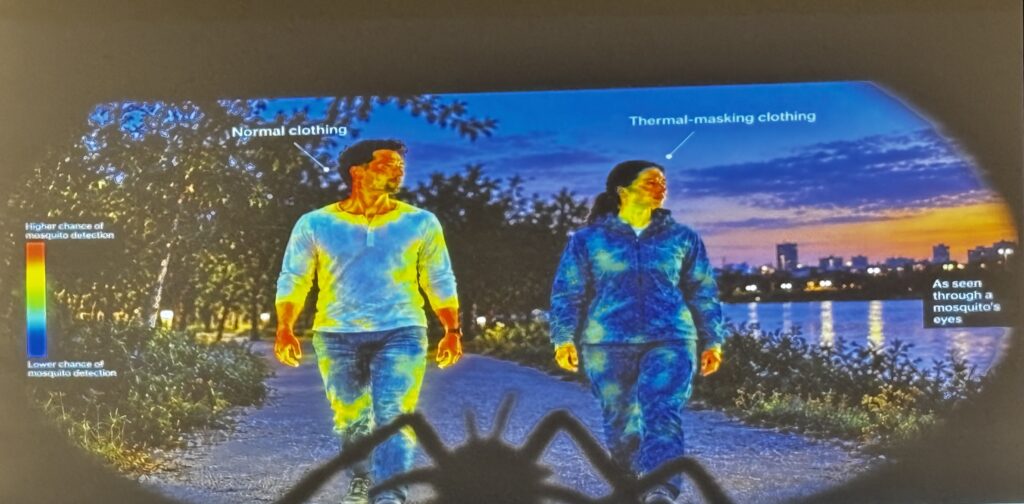
A completely different scientific approach involves chemical strategies for “thermal-signature confusion” to create mosquito proofing clothing. “Once a mosquito is close, they look for heat. Clothes that blur the sight of heat would confuse the mosquitos,” he explains. Certain chemistries and materials are able to mask the body’s own heat, which would otherwise be visible to a mosquito. At close range, a thermal masking material exhibits a blurred, lower-contrast signal that’s harder for mosquitoes to pinpoint. (See image below)
Plant fragrances have many practical uses in fabrics, including medical uses that Thompson assures is “real science,” and adds, “There’s a dramatic need to explore medical applications.” Thompson is particularly interested in the possibilities for textiles in enhanced wound care products, especially for burn victims.
“Textiles can act as therapeutic platforms, not just passive materials,” he says, and the fiber structure and chemistry can be designed to mimic nature’s own natural antimicrobials and other healing attributes. These can advance wound care and infection control.
But applications go could go beyond that. “A leaf is a pharmacy,” he says, with anti-inflammatory capabilities, able to inform moisture retention, inspire diagnostic pigments, and create barrier films. There are scents in certain plants that have been shown to prevent seizures, he says, and plants are even able to tell bacteria to go to sleep, “and we don’t need dangerous chemicals to do it,” he says.
Beyond plants
There are plenty of other “biological blueprints for textiles,” beyond plants, such as coloration without dye, inspired by butterflies. Little microstructures in these tiny creatures bend light to create the colors. It’s not pigment and it’s not dye, it’s engineered light. “Just adjust the structure of polyester from its current structure to this,” he says. “We could save a lot of water. It’s not difficult to do, and the colors are vibrant and translucent.”
Shark skin can teach us about self-cleaning, anti-fouling surfaces and drag reduction;
polar bear fur both traps the bears’ heat and repels water; and we’ve all heard about the ultra-strong but lightweight aspects of spider silk.
Thompson says biomimetics can also create a “lenticular camouflage.” By micro-texturing polyester with the right materials near invisibility can be engineered. “This is where cephalopods come in,” he says, with their famed ability to dynamically and rapidly change their skin color.
“Everything that’s happening in nature now, could be developed,” he says. And, as much as AI can be useful in the process of researching and designing new materials that incorporate
biomimicry, “AI cannot duplicate intuition,” he says. “That’s what it can’t do.”
A new, effective biobased fire-retardant
“High performance, biobased fire retardants,” presented by Satish Hodage, chief technology officer and founder, YUJ Labs, Charlotte, N.C., revealed how naturally derived biopolymer chemistry offers a more sustainable fire-retardant solution than halogens.
“The halogenated era is ending,” Hodage says, but adds, “Compliance is only the entry point, not the finish line.” For next generation flame retardants, “performance is the key.” His company is currently focusing on bedding applications.
It’s important to know that the real hazard is the smoke not the flame. “Smoke is what people need protection from.” In fact, 72 percent of fire deaths are caused by smoke and toxic gases, not flames.
Hodage takes his inspiration from nature, which “already makes flame retardant polymers,” he says. These may be plant, marine or algae derived, containing material and chemistries that are natural fire retardants. In Hodage’s product, phosphorus and nitrogen build a protective char, which creates the fire protection. Essentially, the fabric protects itself where it burns, without any halogens.
A flame retardant has to change what the material does when it is heated. Instead of breaking into flammable gases, the solution presented in this session describes a treated fiber-fabric that builds a solid, carbon-rich char, which reflects heat and becomes an insulating barrier, starving the surface of oxygen and maintaining the structure.
A water-based finish with no solvent, it is also antibacterial and antifungal and compatible with existing textile finishing lines, he says. It has also completed a successful testing process. The company is working on incorporating it into the extrusion process, so it would be part of the polymer that is then made into the fiber.
Circularity challenges in performance footwear
When we think of circularity in textile products, a larger picture likely comes to mind. But to make the large picture meaningful, the details of its composition need to be considered. For one researcher, the larger picture is circularity in a ubiquitous product – performance footwear, and the details are the foam in those shoes.
“Circular performance footwear: Linking foam degradation, material recovery, and end-of-life design intelligence,” was presented by Kedena Henriques-Thompson, Ph.D., whose expertise is in Clothing & Footwear Biophysics, and Textile Testing in the Wilson College of Textiles at NC State University.
Performance footwear is made of multiple layers, designed to support activity-specific needs for the wearer. Furthermore, brands use different types of materials – and different types of foam – and they have their own way of assembling footwear’s many pieces. All of this makes for a complicated separation and recycling process.
Dr. Henriques-Thompson examined and tested foam materials used in performance shoes, from new, to during wear, to end-of-life – all of which informs material recovery options. The study’s sample included 10 well-known brands.
There are five types of foam typically used in performance footwear: ethylene vinyl acetate (EVA), polyurethane (PU), polyether block amide (PEBA), thermoplastic polyurethane (TPU), polyethylene (PE). Of these, PU has the largest environmental impact.
But where, exactly, the foam degrades, which impacts the shoe’s performance and the wearer’s comfort, varies with use and individual gait. Even so, the study was able to identify material claims and evidence gaps.
She was also able to make some conclusions regarding circularity. Essentially, for brands, “recycled is what they want to say,” she says. Typical claims – recycled and/or recyclable, bio-based, biodegradable, take back – may sound straightforward, but there is more evidence to check.
In recycling claims, what’s the content record and chain of custody, as well as separation, route and acceptance criteria? If it’s biobased, what’s the content test and formulation record? If it’s biodegradable, what are method, conditions, time and residues? With a take-back program, what is the return rate, destination and recovery yield? The fact is return models are sparsely recorded at end-of-life, and there are no repairs recorded. In the end, a shoe should serve the wearer well — and have a credible path for its materials afterward, she says.
Janet Preus is senior editor of Textile Technology Source. She can be reached at janet.preus@textiles.org.