 TEXTILES.ORG




One might be tempted to question why we in America should care about the technical textiles sector beyond U.S. borders. The U.S., along with the EU, take the lead in industrial, nonwovens and functional materials—sectors that grow at least on par with the GDP growth rate in developed economies. In developing and emerging economies, such as India’s, the sector’s growth is in double digits, giving a boost to manufacturing and research.
While these growth rates are positive, developed economies still depend on other manufacturing countries, such as China, for life-saving products including personal protective equipment (PPE), masks and other critical medical supplies. According to the American Medical Manufacturers Association, 79 percent of PPE items, 59 percent of wound care and 64 percent of respiratory items are imported into the U.S.
Oil production and supply offers another illustration. The U.S. is the world’s largest producer of crude oil, but even a slight disturbance in oil production in the Middle East can push up the price at the pump in West Texas, an oil belt in the U.S. As a case in point, oil in Lubbock was in the $2.00 to $2.50 range per gallon before the Iran war, while it is, at this writing, at $3.99/gallon highlighting the economic effect due to global connectivity.
Similarly, supply chain disruption in critical care items can increase medical care costs and even cost lives. It is in the interest of the U.S technical textiles sector to have up-to-date information about other countries’ technical textiles manufacturing capabilities, product developments, R&D, investments, governmental policy initiatives and supply chain issues.
A global perspective
Both conventional and advanced textiles sectors are seeing growth in developing economies, while it is primarily advanced products experiencing investments and growth in the U.S. South and Southeast Asia have become textile manufacturing powerhouses with China leading the pack. Scale, cheap labor, competitive cost of production, supportive policy initiatives, availability of land, cheap power and fewer regulations have fueled the growth of textiles and other manufactured products.
China also started developing its nonwovens and industrial textiles base in the 1990s, making it an important export player in some PPE products. China’s research in the sector is active in some state-owned laboratories and university systems, such as Shanghai-based Donghua University and the Hong Kong Polytechnic University (HKPU). HKPU has pioneered research in functional and wearable textiles that resulted in “Walter,” a sweating fabric manikin used in developing advanced thermal comfort garments.
Since the 1990s, research on nanofibers has become a phenomenon due to the efforts of Jayesh Doshi and Darrell Reneker at the University of Akron in Ohio. This effort led to eSpin Technologies and global research in nanofibers in many leading research universities, such as the National University of Singapore (NUS).
Prof. Seeram Ramakrishna’s group at NUS is effectively utilizing electrospinning nanofiber technology to develop nano composites for biomedical and industrial applications. Today, nanofibers have penetrated different applications such as toxic chemical decontamination, and filtration due to productivity increase and scaling-up of the process.
Machinery matters
Czech-based Elmarco evolved out of the Technical University of Liberec. The company specializes in nanofibrous materials through its own electrospinning technology, and it is a global supplier of industrial electrospinning equipment. This technology utilizes drum/cylinder enabling production enhancement.
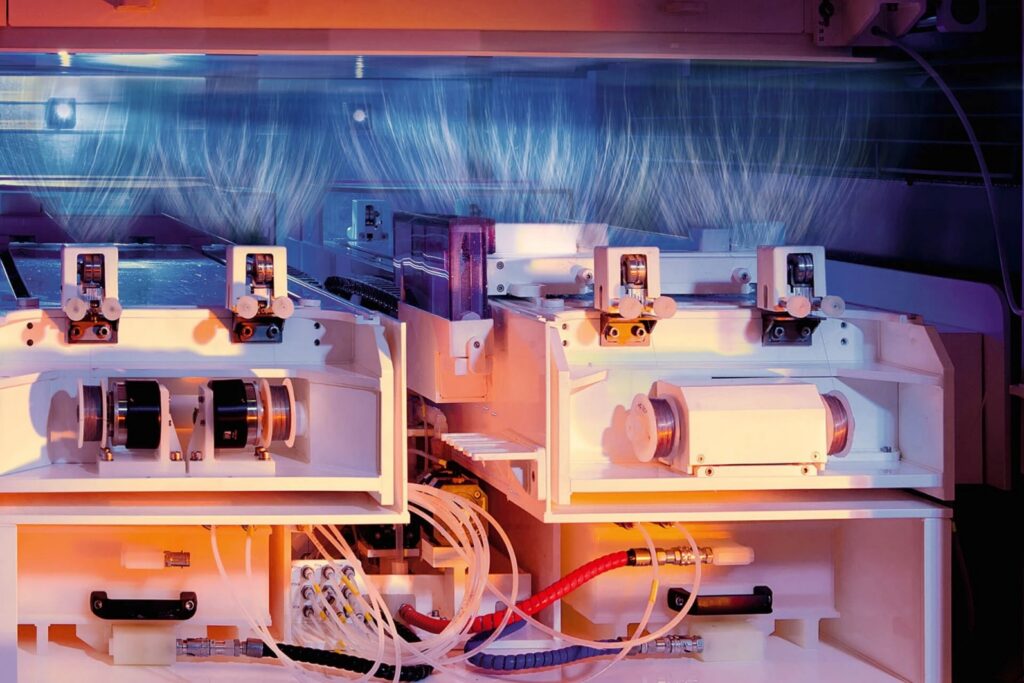
Currently nanofibers are used in all highly efficient filters, and they are made using technologies that involve: 1) electrospinning using needles and cylinders, and 2) a centrifugal system. Recently, productivity of a needle-based approach has improved as exhibited in machines from companies like the U.S.-and Turkey-based Inovenso. The Nonwovens & Advanced Materials Laboratory at Texas Tech University is focusing on combining electrospinning and high energy plasma technology to develop advanced textiles.
Textile machinery developments focus on energy efficiency and automation. European countries, including Switzerland, Germany and Italy, are still leaders in the manufacture of conventional and nonwoven machinery. China has strengthened its spunmelt nonwoven machinery sector, catering to narrow-width machines.
India has a world-class spinning machinery manufacturer, Coimbatore-based LMW Ltd. (formerly Lakshmi Machine Works), which was started as a collaboration with Winterthur, Switzerland-based Rieter. However, its post-spinning machinery needs to be strengthened, as well as its post-weaving and knitting manufacturing sectors. The Indian government has initiated national missions to promote technical textiles and boost cotton quality and productivity.
Global and regional
There are opportunities for mechanical engineering-based industries in the U.S. to establish their presence in Europe, Asia and Africa. In particular, the converting machinery sector for advanced textiles, including coating machines, plasma processing machines and supercritical fluid technologies, have opportunities in untapped markets. Companies via mergers and acquisitions can acquire research, testing and sale agencies to expand their market.
Growing uncertainties regarding fuel costs, transportation barriers and travel situations are encouraging industry to have regional customer service centers. Maxcess Intl., which does web handling, has acquired International Cutting Die Inc. [ICD], which has strengthened its position in the growing nonwovens market. (Web handling is a method of guiding, controlling and converting web materials, including nonwovens and other textiles, in large quantities.) Headquartered in Illinois, the company has relocated its European production site to Lubowo, Poland, which will strengthen Maxcess’ global footprint, as well as manufacturing tungsten carbide cutting dies, due to its ICD acquisition.
“Opening the European service station allows our customers to utilize a local center for repair and servicing of critical assets we manufacture and maintain. It saves them logistical costs and limits downtime. It also opens opportunity for ICD for new products that an abroad site specializes in producing,” says Brian Stowers, business development manager, Maxcess/International Cutting Die.
The advanced textiles sector in stagnant economies can look into strategic collaborations that can give access to production, research and service centers in emerging markets. India, for example, has vibrant programs to attract international high-tech technology and manufacturing companies with favorable foreign direct investment policies, providing infrastructure facilities in export promotion zones, as well as other helpful incentives.
Even in the present volatile economic situation, Indian Prime Minister Narendra Modi has made a five-nation trip that included The Netherlands, Sweden and Norway. Speaking at the European Round Table for the Industry in Gothenburg, Sweden, Modi enticed foreign businesses to invest in India by highlighting schemes like Production Linked Incentive and foreign direct investment (FDI) reforms.
Finland-based Ahlstrom started manufacturing spunmelt nonwovens, which are used for breathable viral barriers, in Mundra, India. India is transitioning from making basic textiles to high performance materials with major investments by Global Nonwovens, with the installation of multibeam spunmelt lines from Reifenhäuser, Germany
From adversity to opportunity
Industry should utilize this stressful time for strategic planning and diversify into high-value products for functional and life-saving applications. Given the problems associated with transport and cost of fuel, the technical textiles sector in developed economies can collaborate with major textile markets to establish joint ventures and manufacturing.
Even in developed economies, particularly in the U.S., there are requests from industry and trade associations to support procurement of domestic products like PPE. Associations, including the American Medical Manufacturers Association and the National Council of Textile Organizations, are promoting “Made in America,” as this is a priority policy of the current U. S. administration. While it is not economically advantageous to promote the manufacturing of low-end and commodity items in high-income countries, advanced textiles provide growth opportunities in both developed and developing nations.
Promising R&D worldwide
The Swiss federal research agency Empa-Swiss Federal Laboratories for Materials Science and Technology is undertaking research on specialty fibers and chemicals. As Empa is a taxpayer-funded agency with about 60 percent of its budget from government, they would be willing to transfer technologies and collaborate with small-and-medium enterprises in advanced textiles fields.
Empa is promoting a new research theme, “Safe and Sustainable by Design [SSbD],” to develop safe alternatives to toxic chemicals used in the textile industry. A research team headed by Dr. Dirk Hegemann is collaborating with multiple Swiss industries to develop plasma coating technique to apply thin layers of PFAS-free chemicals to achieve both environmental and economic sustainability. Enormous opportunities are available for the functional textiles industry to come-up with PFAS-free fire fighter gear and protective garments.
In Empa, a pan-European project involving 29 countries is working on the risk assessment of chemicals and novel materials like graphene. In Germany, Fraunhofer Institutes are involved in applied research aimed at solutions to problems faced by the industry. The Institute of Textile Technology, RWTH Aachen, in Germany is a leader in research on sustainability and industrial textiles working towards transferring the European textile industry.
The European Union-funded AUTOLOOP project, led by Fraunhofer Institute for Environmental, Safety, and Energy Technology, focuses on developing a closed loop system for textile waste aimed at processing 1.24 million tons of textile waste by 2050. In addition to smart textiles and circularity, countries are focusing on sustainable and alternative fibers, broadening their product basket, fashion prediction using AI and machine learning, and functional finishes using biobased materials.
Textile manufacturing in India is endeavoring to use green energy to save costs. In new investments, the cost for wind or solar is included in loan applications, says Velmurugan Shanmugam, general manager of the 70,000 spindles spinning mill Aruppukottai-based Jayalakshmi Textiles in India. This mill has a total of 12 megawatts of wind and solar power which helps to save energy costs by about 45 percent. In challenging times, the profit is based on the savings in energy cost due to captive utilization of alternative energy generated by mills, Velmurugan Shanmugam explains.
Strategic partnerships
It is inevitable for advanced nations to engage with low-cost textile manufacturing countries to deliver products at affordable prices. The engagement should not be strictly between business to business, manufacturers to suppliers, and retailers to suppliers. Professional and trade associations in the U.S. should collaborate and engage with those in other textile manufacturing nations. This will build relationships between the workforce, researchers and policy makers between nations.
The American Association of Textile Chemists and Colorists (AATCC) has been active in this arena. India being a largest exporter of textiles and apparels, over the past two years, AATCC has been reaching out to academic institutions and industry in India, an effort that has resulted in the creation of five student chapters in Coimbatore, Chennai and Bengaluru—all major textile and garment manufacturing centers.
“Today, less than five percent of all clothing sold in the U.S. is made domestically, and the U.S. industry continues to contract. India’s textile industry is growing fast, leveraging its natural fiber advantage—while aware of the opportunities in synthetics—has cost-competitive labor and a government enacting policies to capture global opportunities, particularly as brands diversify from China,” says Gregg Woodcock, AATCC executive director. “It is critical that AATCC continue to build relationships across the globe, with a strong emphasis on collaboration with the Indian textile industry.”
As AI is the latest technology making waves, Bengaluru-based Stylumia, which pioneered the use of machine learning in predicting fashions and enabling circularity, has joined AATCC as a corporate member. This is remarkable as this expertise will help textiles and advanced textiles sectors in developed economies as well.
“We live in a constantly evolving industrial environment that calls for collaboration at each level of every industry, which includes textiles. This provides opportunities to make better products, and educate consumers about products, quality and performance at various price levels,” Kanti Jasani, AATCC board member says. “With AI beginning to play a role, everyone has an opportunity to know which is a better product at the best price for one’s needs.”
The importance of collaboration has economic and technological benefits. “We are continually seeking to collaborate with OEMs and end users on innovative technologies that will help both parties gain market share and benefit from ground-floor opportunities,” says Kevin McEnery general manager, Maxcess/International Cutting Die (ICD).
The need has shifted from local to global collaborations between research institutions and industry, as is the case with Coimbatore-based Kumaraguru College of Technology [KCT]. “The larger intent is to move from isolated institutional research toward globally networked knowledge creation, where collaborative ecosystems accelerate innovation, interdisciplinary thinking and societal impact,” says Dr. Vijila Edwin Kennedy, director, Global Engagement Office, Kumaraguru Institutions.
Kumaraguru College of Technology has recently formed a student chapter of AATCC strengthening its engagement globally with a professional association. While establishing collaborations, institutions and regional strategic strengths help with the growth of a sector. Dr. Kennedy adds, “By leveraging Coimbatore’s industrial depth, interdisciplinary capabilities, applied research orientation, and growing international engagement efforts, Kumaraguru institutions aspire to build a globally distinctive model of collaborative research that moves from transactional partnerships to transformational ecosystems.”
Agreeing with this view, Professor Appavu Pavendhan, associate dean, School of Textiles, KCT, says, “By intertwining local expertise with global networks, KCT is committed to shaping the future of textiles—fostering an ecosystem where research thrives, and innovation knows no borders. We welcome continued dialogue and deeper collaborative ventures with like-minded Institutes worldwide.”
Interesting developments
Recently with increased awareness on sustainability, conventional fibers such as cotton and wool are finding increased applications in hygiene, healthcare and environmental protection. Texas-based Simpleaf is looking into taking cotton into advanced products that can find applications in hygiene and environmental clean-up.
How many of us would have thought of wool being a part of diapers? New Zealand-based Woolchemy has come-up with neweFibre™ which is used in the manufacture of a nonwoven acquisition distribution layer (ADL), effectively taking advantages of wool such as breathability, thermal control and odor control.
Chennai, India-based Asthagiri Herbal Research Foundation (AHRF) is promoting the use of plant based herbal products in functional formulations. They have extracted active compounds from neem, which have medicinal properties. Neem trees are native to India and other subtropical locales. This foundation operates a private research laboratory which is sustained from grants and contracts from Indian governmental agencies. It releases products on its own and is willing to engage with parties in licensing its technologies.
A welcoming aspect of AHRF is that it works on projects funded not only by government, but also from industry in the U.S., such as chemical company Hexion and drug discovery company Renovel Inc. Such USA-India partnerships help to speed up innovation more economically, and they are a good model for a cost-effective innovation ecosystem.
The global economy is moving into the space of “green” and “blue” economies, i.e., focusing on sustainability and an efficient marine ecosystem. These offer opportunities for advanced textile technologies and products, and, even in stressful scenarios such as the present one, there continue to be markets for hygiene products, and critical needs applications. The advanced textile sector has a range of products that are always needed in wartime situations. These are reasons enough for the advanced textiles industry to be constantly innovating.
“It is a mistake to reduce R&D innovation by any country or company as it limits scope for growth. Collaboration can reduce overall cost of research and provide better product outcome,“ Jasani says.
One avenue is to foster collaboration and engagement with other countries. This not only enables new products but can also reduce manufacturing costs. Continuous outreach by industry and engagement globally have become necessities in today’s market environment.
Dr. Seshadri Ramkumar is a professor in the Department of Environmental Toxicology and The Institute of Environmental and Human Health, Texas Tech University, and a regular contributor to Textile Technology Source.